
Books: Six Weeks on the Throne
At 19, I was on a language study abroad trimester in Granada, Spain. During a school break for a religious holiday (in Spain, there was a religious holiday just about every other week), two friends and I decided to take a train to the southern coastal town of Algeciras, where we would take a boat past the Rock of Gilbraltar to the northern Morrocan port town of Tangiers.
As part of the agreement we had signed to enroll in the language study program, we had expressly promised, upon threat of expulsion, NOT to travel to Morocco.
So we arrive at Tangiers, and found a throng of Moroccans awaiting the boat, offering various services; lodging, tour guiding, restaurants, etc.
We declined the help. We were “poor” college students. We took out our trusty map and hiked into town.
We found a restaurant. Haggled for dinner. Some of the men and boys who had offered their services at the dock trailed after us, milled about, hurled a few insults. We tried to pretend we didn’t hear them, didn’t understand.
We then inquired at a hotel. Took a room. As we’re taking off our backpacks and looking around at the spartan room (three cots and a bathroom which consisted of little more than a sink and a hole in the tile floor – no toilets or toilet seats. You need strong thighs), we hear raised voices out in the street. The voices grow louder. Then a rock comes through the window. Glass shatters. More rocks. We hit the deck. Each crawls under the nearest deck, using his backpack to shield himself from projectiles.
The barrage lasts maybe a minute, a minute and a half, and then stops.
Let’s just say that starting the next morning, we hired a guide to take us to the train depot, then hired guides at our successive stops in the inland cities of Meknes and Fez. Our lesson had been learned quickly, and we encountered no more problems.
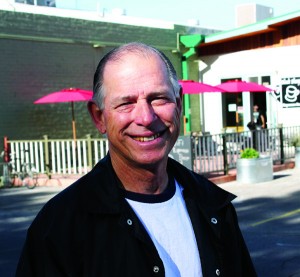
Rick Frey.
It is near impossible to read Rick Frey’s charming, autobiographical seafaring tale, “Six Weeks on the Throne,” without reflecting upon one’s own adventures, both taken and not taken.
Rick was 19 at the time he decided to impulsively stow away on a luxury cruise liner traveling from Honolulu to London via Tokyo.
Hailing from suburban L.A., Frey had just finished his second year of college at what would become Cal-State Northridge. He and a buddy decided to spend that summer as surf bums in Waikiki.
As a quaint sign of the times, Frey went over with all of $140 in his pocket.
It soon became clear that he would either have to find a job or return to California before the end of the summer, as his father had predicted.
So Rick found a temporary job with the Dole Pineapple Company picking pineapples on the island of Lana’i.
Of course, picking pineapples wasn’t what he’d come for.
Just about this time, a friend’s girlfriend’s parents happened to be stopping through Honolulu on a British passenger liner, the S.S. Iberia. Rick was among those invited aboard for dinner.
A chance conversation with a crew member led to a hypothetical conversation about stowing away. The crew member then gave Frey his crew pass and said if he had the courage to give it a shot, he’d meet him on the fo’c’s’le (the raised portion of the bow) two hours after the ship left port.
Frey went home, gathered a few belongings, returned to the ship, and took off. He had no passport with him, no driver’s license, and about $70 in his pocket.
It was 1966.
Eleven weeks later, Frey had stowed away on two different ships and circumnavigated the globe, returning to Southern Califoirnia just in time for the fall semester.
The title of the book is a double entendre which refers to where Frey slept during the majority of his travels on the S.S. Iberia – in the public bathrooms on the ship.
While the cover art of the book is uninvitingly cheesy, and the momentum of the book slows a bit after Rick manages to disembark in England (by jumping off the deck of the ship fully clothed into the water in the middle of the night while docked at Southampton), the first 200 pages of this autobiographical tale are quite good, and certainly speak to the young adventurer in us all.
As Frey said in an interview with The Sheet, “It changed my life. It was an awareness thing for me. That the world is neutral has been one of my four or five anchor points … life is about what you do with what happens to you. You can either fold up [when confronted with challenges] or make them into a positive.”
Frey has been a Bishop resident since 1996 and currently works at the Toiyabe Indian Health Project. His two sons grew up in Bishop. He has been married to wife Kim for 28 years.
He was formerly on the faculty at the University of Alaska-Anchorage, where he had a joint appointment in education and health science.
He is also pretty much the youngest-looking, most energetic 67-year old you’ll ever meet.
The Booky Joint is hosting a book signing for Frey and Stapp this Monday, beginning at 1 p.m.


