
Catching up with Rick Devore at Apple Hill Ranch
Rick Devore doesn’t look a day over 50. But the 77 year-old great grandpa is working on yet another career. Devore owns and operates Apple Hill Ranch, the only USDA certified organic farm in the region. Located at the end of Sierra Grande Road off of Gerkin Street south of Bishop, visitors can pick their own produce, picnic next to the pond, or simply purchase fresh eggs, goat dairy products, honey, home-made jams and organic produce from a small fridge underneath the blue tent next to the shed. “It’s on the honor system,” Devore said, pointing to the open cash box that also sits in the fridge.
“It’s a hobby that is out of control, but this is how I keep my sanity,” said Devore, who also runs his own commercial and residential real estate office. “It’s seven days a week for me for sure,” he said. “Real estate is really demanding. When you gotta work, you gotta work.”
Devore runs Apple Hill Ranch with the help of one other man, Manuel, who has been with him for 15 years. “Between the two of us, we’re it,” Devore said. Apple Hill is open 7:30-4 p.m. Tuesday through Sunday but is closed on Mondays so Devore can work in his real-estate office.
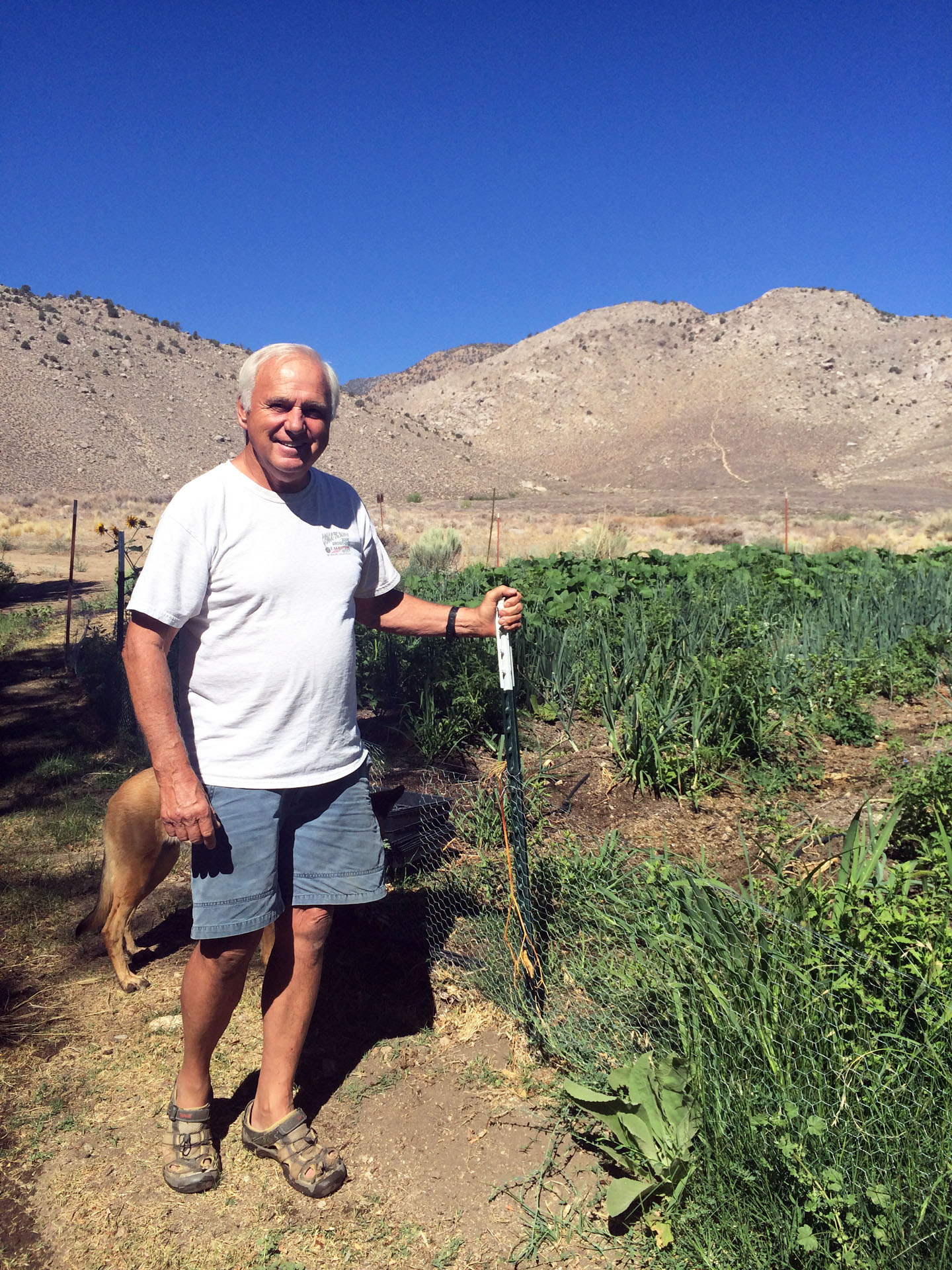
Rick Devore.
“I read up and study everything. Everyday, you’re learning something,” Devore, who is a self-taught farmer, said about the Apple Hill. He has 17,000 trees including apples, peaches, pears, plums, walnuts, cherries and pecans. One of his fig trees comes from a 150-year-old homestead on the other side of Owens Valley. “I just grabbed a branch and planted it,” Devore said. Last year, a man visited Apple Hill who grows over 900 different types of figs from the Middle East and told Devore he has never seen anything like the fig from Owens Valley. And just three weeks ago, Devore said he picked 1,000 pounds of apricots that are already gone.
Devore also has five gardens on his property, growing a variety of produce including kale, beets, tomatoes, onions, cilantro, cucumbers, squashes, and beans. He pointed out a torn up parcel of land saying that they had just harvested garlic and will soon plant beans in the same spot. “The [beans] replenish the soil and put nitrogen back in it,” he said. Devore grows elephant garlic but also Russian garlic he received from a customer who brought him back some from their travels.
“They are really good watch dogs,” Devore said about several peacocks that roam the property. “And the kids love them,” especially the one white peacock named Prince. Devore also showed off his hand-built chicken coop, “with privacy curtains for the girls,” and anyone is welcome to collect eggs. But when you visit Apple Hill, either to buy or pick your own, make sure to close the windows of your car and watch out for a black chicken. Devore got the chicken from clients who moved out of the area, “She arrived by car and ever since she’s looking for a ride home,” he said, laughing.
After a tour of the Ranch, I sat down with the gentleman farmer in the shade and listened as he explained his long and rich history in the region, his motivation for going organic, and his obvious determination to keep working.
Devore met his wife, Lauralee, in Reno while serving in the military in Reno between the Korean and Vietnam wars. Lauralee grew up in Bishop and her father owned a commercial bakery that Jack and Erick Schat (of Schat’s bakery) both worked at, alongside Devore.
After they were married, Devore and Lauralee moved to Wilkerson, south of Bishop, in 1967. Devore worked at two gas stations in Bishop for $2 an hour, while renting a house for $100 a month. One day a customer came in and offered Devore a new gas station he was building in Mammoth. “He told me ‘I don’t think there is anybody else who could run it,” Devore said.
Devore had recently been offered a management position with Standard Oil, but it would require him to move to LA, so he accepted the position in Mammoth instead. “The first winter, we didn’t get the paving done,” he said. “I had to pull cars through the mud since it was an early winter but then warmed up.” Devore’s Mobil station was located where the Shell Station now is on Center Street.
After 20 years running the gas station, and building an additional station in Lee Vining, Devore decided to retire. “On my last day at the station, my gross dollar amount was twice as much as the first year,” he said. “When I sold out, it meant I didn’t have to work anymore.”
At the time, Devore and his wife owned Rainbow Tarns, just south of Crowley Lake, which they originally purchased for $35,000. After building additions to the original one room cabin, they had it permitted to become a bed and breakfast but decided against it. But Devore’s hopes for retirement were short-lived. After selling the gas stations, Devore’s good friend invited him to get his real-estate license and come work for him. Devore didn’t think he could even pass the test, but when he did, his next career began.
Devore’s first real-estate client was none other than Jack Schat, whom he used to work with and who owned the property that is currently Apple Hill Ranch. “I used to walk up here so my son could play in the crick,” Devore said about Apple Hill. “It was a junkyard. People thought it was DWP land but it wasn’t.”
Although Devore himself was interested in the property, Schat was looking to sell for much more than Devore could afford. “He wanted the moon, stars, and the skies for it,” he said. The 20 acres was zoned for development in half-acre parcels.
Eventually, however, the two agreed on a price.
“There was a mount of trash and a vacation trailer on the land,” he said. “There were no roads and no electricity. There were engines everywhere and marijuana growing along the crick.”
Devore said everyone thought he was nuts for buying such a dump, but Devore worked all summer to clear off the property. The property is surrounded by Bureau of Land Management land and Devore had his fair share of arguments with the BLM and other neighbors. “We took the land by storm,” he said.
After noticing, “There’s apples on this hill,” Devore named the property Apple Hill Ranch.
That was in 1988 but it took Devore three years to really get the orchards and crops going. I asked Devore what made him want to get USDA certified organic, since it is rumored to be a complicated and costly process. “The cost of doing it might not be worth it,” Devore said. “But to me it’s very important.”
15 years ago, Devore was diagnosed with prostate cancer and the doctors told him he’d have to undergo chemotherapy. “But I told them, let’s try something else. Let’s try a different diet.”
Devore said he began feeling better right after switching to an all-organic diet and soon the prostate cancer was gone. On a recent visit to a new doctor, Devore was told his physical shape was that of a 45 or 50 year old. “He said, ‘there’s no way you were born in 1937.’”
Instead of using chemical pesticides, Devore uses a natural one that emits pheromones. “It screws up their mating cycle,” he said, about the pests, including the codling moth that specifically targets apples. His cherry orchard is also popular with local birds, but Devore found putting a netting system over the trees solved the problem.
One of Devore’s most popular fruit is a type of nectarine nicknamed ‘ugly nectars’ because of the way the fruit looks. “If you give me some DDT, I’d make them look like the nectarines at VONS but you wouldn’t want to eat them,” he said.
“That’s gold,” Devore said, then pointing to a massive compost pile made of horse manure and cow manure, along with scraps from the Ranch. “We’re very careful about what we put in there.”
Devore has his own commercial well and can run Apple Hill Ranch, which includes his own house, completely off the grid. “So far, we’re in good shape,” Devore said about current drought conditions. Devore gets all of his water from Coyote Spring. “It comes right out of the Sierra up there,” he said. “I have an excellent well. We’re right on an earthquake fault and have an endless supply of water.”
Apple Hill is open for picking all year. Devore starts all his seeds in his green house during the winter. “There’s always lots of stuff to be picked,” he said.


