
Augie’s march to 100
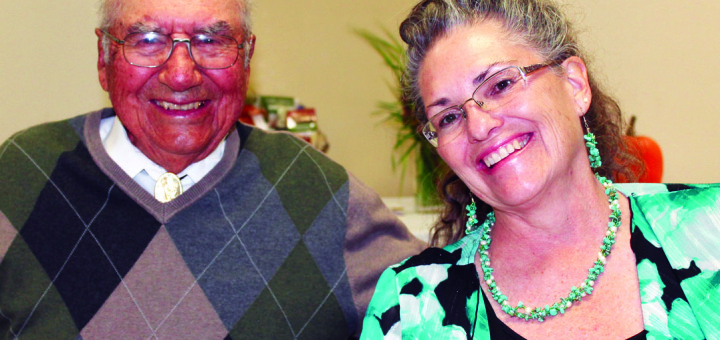
Born in 1914, Augie Hess has seen the Eastern Sierra change over the last century. The son of a Swiss immigrant and a Mono Basin Paiute and born at Mono Mills, Hess knows more about local history than almost anyone around. As an active member of the Mono Basin Historical Society since its inception, Hess was celebrated at the group’s monthly meeting at the Lee Vining Community Center on October 6.
“The historical society has taken advantage of Augie’s willingness to tell his life story and to talk about the different aspects of the local history,” Dave Carle, president of the Mono Basin Historical Society, said. “He’s our most honored elder because he’s the oldest. He’s a very integral part of our society.”
“I just can’t think that I’m that old,” Hess told the crowd on Monday night. “This country certainly has changed in the last 100 years and I’m very proud to have seen it all. God willing, I’ll see you in my 110th year!”
He said the biggest changes to the region have been the road improvements. “I remember the horse and buggy days. And then roads had big ruts, rocks and gravel. The change to the freeways of today is a big change,” he said. “And everything has changed with the technology of computers.”
Prompted by questions from the audience, Hess talked about growing up in Lee Vining, his military service, ski racing days, and his love of golf, which he still plays 3 times a week in Bishop.
The biggest question Hess regularly hears is his secret to longevity. “A lot of people come and ask me about my longevity in this world but I can’t explain it,” Hess said. “I think you have to be real active when you get older you have to do a lot of walking; don’t just sit in front of the TV and watch it all day long. You’ve got to get out and do some exercise.”
Hess told the Sheet his favorite hike in the area is what he called the ‘Indian Trail’ from Yosemite to Mono Lake. The Paiute Tribe does the trek once a year. “They want the younger generations to keep the traditions going,” Hess said.
“The trail was used before there were any roads in the area,” Hess said. “They would bring their goods to trade with the Yosemite Indians.” The trail is 52 miles and takes about 4 days, Hess said.
“The guy upstairs really helped me out. I never had no trouble at all with sickness,” Hess concluded. “I got along with everybody. And that’s about it.”
Hess’s father came to the Eastern Sierra from Switzerland and worked in the gold mines at Bodie and Mono Mills, where he met and married Hess’s mother, a Mono Basin Paiute. With both parents working at the Mill, Hess was born there but spent most of his early days with his maternal grandparents at Rush Creek near Mono Lake.
“It was a really nice place—A big meadow with horses and cows,” Hess remembered. “I didn’t know any other language but the Paiute as I was growing up.”
Hess learned English in the Old Schoolhouse, that is now part of the museum in Lee Vining operated by the Historical Society. Hess and his siblings hiked 2 miles to school everyday, except on stormy days when his father would drive them. By this time, Mono Mills had closed and his father started the first service station in the area at Tioga Lodge.
Hess’ father “catered to the big cars” at the station, who came to the area over Tioga Pass. The “pass was very rough with a lot of switchbacks and it was just a one-way road,” Hess said. “My dad sold a lot of tires because the roads were so rough and the tires wouldn’t hold up.”
Each year, the owner of Tioga Lodge, Mrs. Cunningham, would have a large powwow with Paiutes from Coleville to Lone Pine. The party would last 3-4 days and Hess remembers the large gambling games that would last the entire time, with substitutions as needed.
“And then the white man would get in on these games and they would wait until the Indians were quite established, you could say, and then take them for all they were worth,” Hess said. “But the Indians didn’t care. They were having fun. When they got done with the celebration they went back to their work as usual.”
Hess learned to ski at Tioga Lodge when an Austrian skier started a small ski school nearby. “That’s where I learned to snow-plow and the Christies and all that,” Hess said. “I got pretty good at skiing.” In the 1930s, Hess was on the Mono Ski Club, and competed against the Eastern Sierra Ski Club, with members like Dave McCoy and Cliff Banta. He remembered the yearly competitions where “Dave McCoy would win it one year and I’d win it the other year,” he said. “Just before I went into the Service we had a big battle again. A bunch of us climbed McGee Mountain and had a downhill race. And I beat Dave McCoy by three fifths of a second.” Hess said.
“I knew Dave McCoy quite well,” he continued. “We used to go up to Mammoth and he had a little rope tow.” When McCoy started Mammoth Mountain Augie “enjoyed the big crowds” but “it didn’t matter too much” since he still went skiing in the backcountry on his own.
Hess also recalled serving during World War II, as a plane mechanic for the Army, stationed in the Mediterranean and North Africa. He enlisted in 1940 before the war started and remembers being on base in Seattle when he heard that Pearl Harbor had been attacked. And he was at a landing field near the Leaning Tower of Pisa, in Italy, when the war ended.
Although Hess left the area several times for college and while he served in the Army, “I also loved Mono Basin so I always came back,” he said. “I always loved the country up here, the skiing, fishing and hunting.”
After working at Tioga Lodge, Hess’s dad helped found Lee Vining with Chris Mattly, establishing the first service station. Hess and his brother Stanley continued operating the service station. Hess also worked in the mines and did some ranching, in addition to being a mechanic.
Hess’s dad also built a dance hall in the early 1940s, “with hardwood floors and everything,” he said. As a musical family, Hess, his dad, and all his siblings played in the band at the Saturday night dances, where miners, workers for the LA Department of Water and Power, and locals all came out. “We seen a lot of fights with everybody drinking of course,” Hess said about the dances. They played until the early ‘60s when “the TV came in,” and people stopped coming, he said.
Hess was also a great baseball pitcher and was almost drafted by the minor league before WWII, according to Carle. After the war, Hess organized local baseball teams in the area. Alan Blaver, Hess’s nephew, remembers one particular game against the Marines stationed out of Pickle Meadows when he was a junior at Lee Vining High School. “I played shortstop and we were short a pitcher,” Blaver said. Hess “got in there and threw smoke. He was walking on fire. It was really amazing and we ended up beating them.”
A lifelong Giants fan, Hess often listened to the games on the radio at his service station. Tom Paranick remembers listening to some of the games as a kid. “He would have the game on the radio at his old station and the guy that owned the Richfield station had the Dodger games on. If the Giants beat the Dodgers the fans would run out [of Hess’] station and “torment” those guys. And vice versa,” Paranick said. “It was great times growing up in Lee Vining back in the day.”
Eventually, Hess switched from baseball to golf. In 1962, Hess was working at his station when a customer came in without money but in need of gas. “Here comes this guy and he had a set of Macgregor iron golf clubs,” Hess said. “And he showed them to me and he says ‘I need gas I don’t have no money, I’ll give you these clubs if you give me a tank full of gas.’”
Although Hess had never played golf, he accepted the payment and went down near Mono Lake to try out the clubs. “I thought ‘oh boy I can do this pretty good,’” Hess said. He made a small driving range, marking off 50, 100, 200, and 250 yards increments and he’s played golf ever since. His daughter Heidi added, “And we never saw him again.”
“The boys at the club really like me,” Hess said about the Bishop County Club, where he now plays. Since the early ‘80s, they have hosted a golf tournament in honor of Hess and his ability to hit the ball straight. The tournament, a 4-man scramble is designed so that “anybody can play it,” Hess said. “It’s a fun deal.” The 2014 tournament will be held at Bishop Country Club on October 25 followed by Hess’s official 100th birthday party.
“I’ll play golf as long as I can,” Hess said.
Prompted by the Historical Society and with the help of his daughters, Heidi and Vineca, Hess self-published his autobiography, “The Kid from Mono Mills,” earlier this year, detailing his life in the Eastern Sierra. The book will be available at the Straight Arrow Tournament or can be found at Amazon.com.


