
Forty men in the dark
-
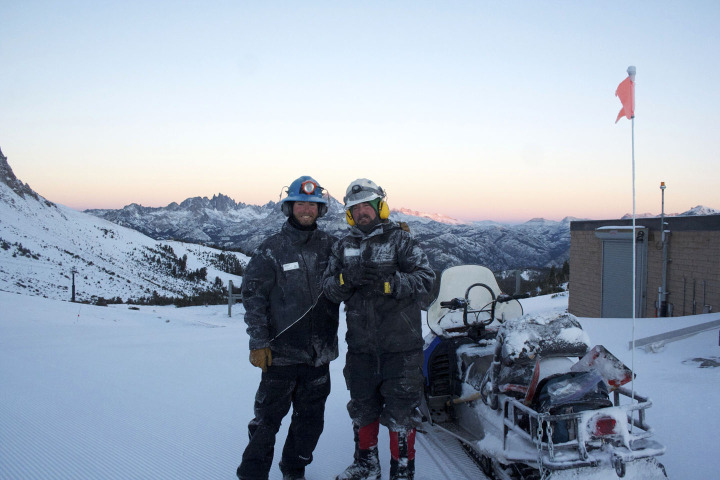 Graveyard snowmakers West Vane and Zeke Morrow take a moment to enjoy the sunrise. Photos courtesy: Vane.
 -
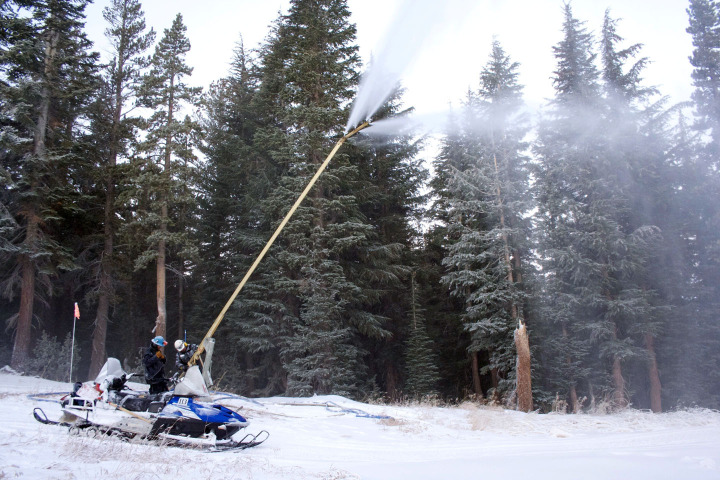 West and Zeke adjust the angle of the tower gun for better coverage on Sesame St. West.
 -
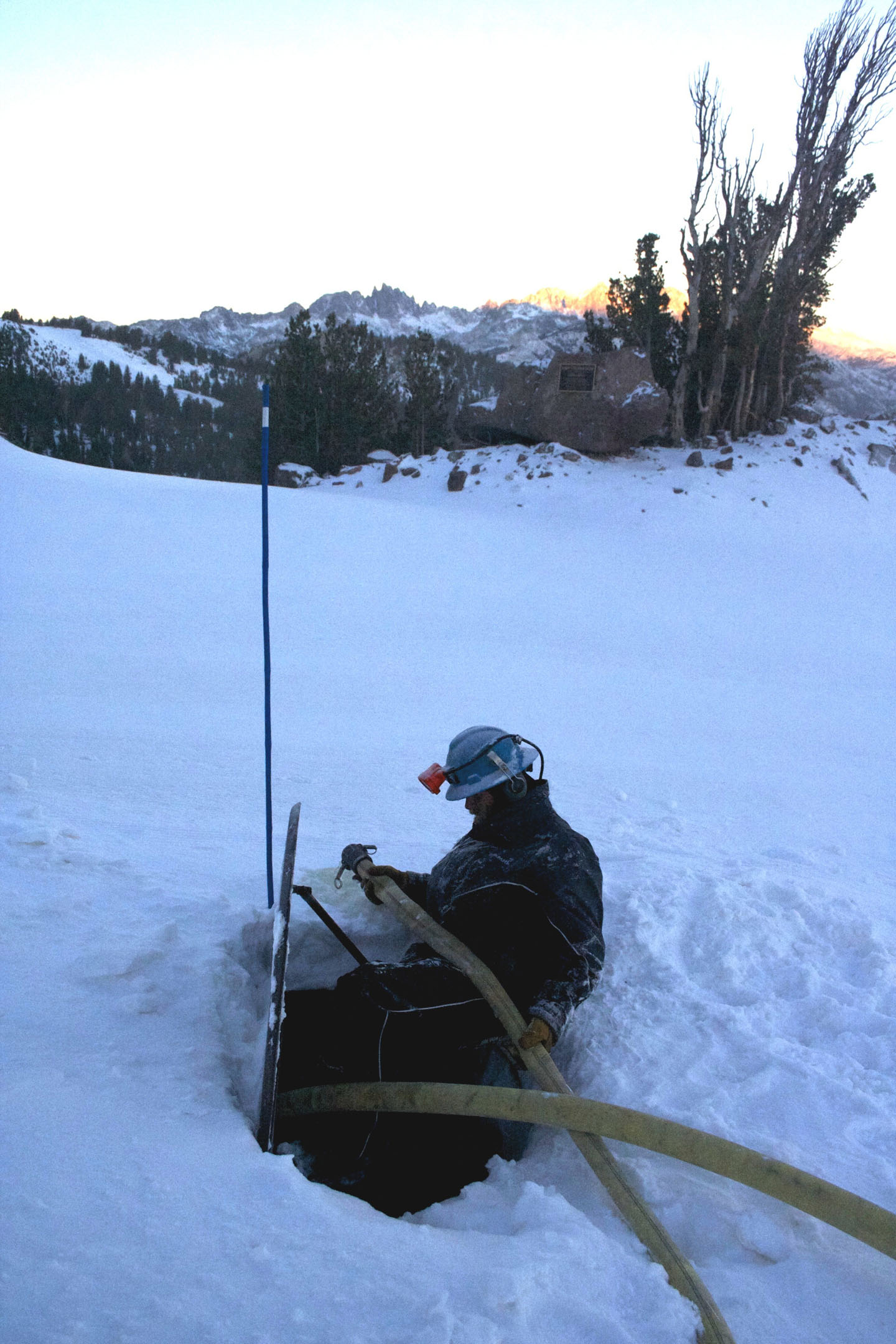 West unhooks the air and water hoses from the hydrants inside the “can” in preparation for stowing the hoses and gun for the day.
Vane takes an early morning ride with the snowmaking crew.
On any normal Friday, my alarm would not go off at 3:30 a.m. But that’s the hour I got up on Nov. 22—voluntarily, I might add—to stumble into warm and waterproof clothes, stuff two pairs of socks and gloves, a balaclava, water bottle, coffee thermos, and sunglasses into a pack, and drive the dark, slippery road up to the Mammoth Mountain Ski Area (MMSA) compressor house.
To say it’s dark on that road at 4 a.m. is an understatement. You might get a little starlight, or the hard, neon glow from the bus depot across from Woolly’s Tube Park, but not much else. Yet the compressor room was incongruously bright: a cavernous room filled with six massive compressors that allow MMSA to pump air out to 220 snowmaking guns in a network that can span the Mountain.
The sound in the room is deafening: a throbbing, ringing hiss. But when I asked the snowmaking crew about it, they were unfazed.
“It’s soothing to me,” said Graveyard Supervisor Jake Allard. “It’s like a babbling brook, after all this time. It’s a good noise to us.”
“It’s the not-normal noises that make you worried,” agreed Control Room Operator Miles Howard. Miles controls all of the water and air used for snowmaking, monitoring the pressure and temperature of the air that goes out on the hill. Water comes from the big pond by McCoy, and from a series of wells around the Mountain, Miles said. The air and water combined is what produces snow.
Up the stairs from the compressors is a narrow hall with a locker room to one side, offices to the other, and a monitoring station, which doubles as a lounge, straight ahead. Here the crew assembles to eat “lunch,” which could be anything from soup to Mexican food, in the wee hours of the morning.
Why was I joining them? Because I volunteered myself for a Sheet assignment, of course. After the snowmaking crew saved Mammoth Mountain’s bacon last season, if not the season before that, I was curious to know who these guys were, and what exactly they did.
Make no mistake about it; this team is all guys—a crew of 40 permanent employees supplemented by employees from other departments, like Cat Crew and Snow Placement, during the early season. Although Jake found a pair of women’s boots for me from God knows where, the graveyard shift members referenced female employees of years gone by as if they were mythical creatures—the burly Alaskan Forest Service woman who worked the ’09 season and talked dirtier than anyone on the crew, for instance.
As I was to learn, you’ve got to be burly to make it on the snowmaking crew.
A little masochistic, too.
My guide for the morning was none other than my brother, West, who began working graveyard shift last winter to make ends meet before the Mountain got enough snow for full-time employment. West explained to me the two shifts: swing, from 4 p.m. to 12:30 a.m., and graveyard, from 12:30 to 9 a.m. Swing sets up the runs, also called “lines,” with snowmaking equipment, and begins the snowmaking process; “We’re the ones who maintain the line,” West said, “either til we lose temps or til we hand [back] off to swing.”
A quick note on lingo, because snowmaking has its own: a “can” is a hole in the ground that holds water and air hydrants. Hoses connect these to a snowmaking “gun,” which can be “low energy,” meaning air and water mixes outside of the nozzle, or “high energy,” meaning air and water mix inside the nozzle.
The guns have nicknames, too, which I don’t have the time or space to go into.
Suffice it to say a gun technically called Baby Snow Giant 2+2 has been dubbed “Berserker.”
Shovels are called “girlfriends” because, West said, “You have to always keep it with you, because if you leave her somewhere, some other dude’s gonna pick her up and bring her home.”
And even after this brief tutorial, you might hear the Supervisor ask a crewmember to “freshen up that break-over,” or “build tracks and come back through the bottle,” and have no idea what any of that actually means.
While my assumption prior to Friday morning was that the snowmaking crew turned on the guns and more or less left them alone, in reality, the snowmaking operation is a complex and committed one.
“Like in any battle, logistics are huge,” said Manager of Snow Placement Brian Bethke. “It’s a whole outdoor operations team effort.”
On Friday, the graveyard shift was about 20 guys operating about 110 out of MMSA’s total 220 guns. One of the perks of the job is tearing around the Mountain on a snowmobile, dragging hoses, or hooking guns onto the back and dragging those to position them for better coverage. The crew does this because the guns must be monitored continually and adjusted to prevent snow from becoming too heavy or too concentrated in one spot.
Clifford Mann, Director of Mountain Operations, likened snowmaking to cake baking. “You change the milk, you change the rest of the ingredients,” he said. In this case, the milk could be air temperature, wind, or altitude.
Snowmaking happens up to about 23 degrees wet bulb (a combination of temperature and humidity)—28 at the most. Initial snowmaking efforts are to create a wet base, while later snowmaking efforts will be to create a lighter, more ridable top layer.
I quickly realized that snowmaking requires an incredible amount of labor, including shoveling snow off the tops of cans, breaking hoses free from frozen ground and eventually rolling them to get them out of the way for pickup, dragging guns to new locations and adjusting their angle, hiking up and down slopes that don’t have enough snow cover to ride a snowmobile, all while getting soaked through by constant snowfall.
West said most rookies are surprised to find they don’t have much time to get cold on the job.
“Honestly, if you get cold doing this job, you’re probably not shoveling enough,” he said.
Zeke Morrow, West’s partner for the shift, admitted the damp was the toughest part of the job. Crewmembers get wet from crouching in cans filled with water, moving under guns, and turning off valves that vent water. After a night and morning of work, “It looks like you took a shower,” he said.
Oh, and the guns make a lot of noise, although the crew wears ear protection attached to their helmets. It’s an incessant, dull level of sound that’s exhausting in and of itself.
Then there are the dangers of the job. On snowmobiles, the crew has to skirt around not only hoses, guns, and cans in the dark, but also into and out of 3 foot-deep drainage trenches with little to no snow cover.
“That’s one of the things that can get you in the most trouble, early season snowmaking,” West said.
Then there’s the considerable pressure of the air and water in the hoses; hoses that the crew must adjust, remove, and replace by the light of headlamps. There’s also the liability to others if a snowmaker makes a mistake. For instance, West said, if a crewmember were to leave hoses attached to the air and water hydrants in a can, a cat crew could easily tear the hoses out—and the hydrants with them. With water pressure at 400-800 psi, West said the water would shoot about 200 feet into the air, a problem that would take about a day to remedy.
Why go through all of this?
Fifth season snowmaker Frankie Monte said he came back to graveyard specifically for the extra $2 an hour. “That’s key, living up here,” he said. He acknowledged that snowmaking can be tough on relationships—most graveyard shift members go to bed around 2-3 p.m. and wake up around 10-11 p.m., and can work up to 12 hour days when temperatures allow—but said it was worth it.
The job has more attractions than just the pay, he said; Frankie and everyone else I talked to agreed that watching the sunrise every day is a unique perk.
“You get a second wind, seeing that,” he said.
“Seeing the change from night to morning, when the sun comes up and you can see what you’ve done, that’s the best part of the job,” West agreed.
There’s also an undeniable camaraderie between the crew, whose members watch TV, eat lunch, and shoot the breeze with the familiarity that comes from working together in an intense, demanding environment.
“It’s a hard job, but it’s really rewarding,” said Bethke. He’s been with the Mountain since 1985, and became a department head 10-12 years ago. He said the largest change he’s seen over his years at the Mountain is the expansion of the snowmaking system.
Mann seconded Bethke. He noted that the system began with about 55 feet of trench for piping. The system now has about 200,000 feet of trench, with about 400,000 feet of pipe.
After the drought year of 1990-91, Mammoth installed the first phase of its existing snowmaking system, including the compressor and main pump house, snowmaking pond, and 110,000 feet of pipe to cover 200 acres of terrain.
Mann said today’s snowmaking system covers about 600 acres.
With this snowmaking system in place, he said, Mammoth has been 24-0 on opening day.
“This year we had probably one of the better on-man-made snow with park openings,” he said. “Stump Alley for this [Thanksgiving] weekend is our next big goal.”
Yet Mann said the Mountain’s snowmaking system “was never sized to run the Ski Area, although we’ve done that the last few years.”
He addressed local concerns about water, considering MMSA is pulling from an already depleted water table to create snow. “We have certainly seen decreased production in snowmaking wells, but production, while less, is still steady,” he said. “Obviously we’re not getting as much as we did in 2010-11, but it’s still pumping.”
Mann also noted that the majority of the water used in snowmaking returns to the ground.
“We’ve got enough water to achieve our primary goals,” Bethke agreed.
Bethke added that the system is becoming more efficient, given leaps in technology like the low energy gun, which uses less air. “We have leaps every year in procedures, First Aid and hazard training, as well,” he said.
But “The biggest thing I’m proud of, and the greatest strength of the snowmaking program, is the crew,” Bethke said. “I’ve done this for over a decade, and I’ve got a 75 percent retention rate. That’s unheard of in the industry. The crew is key to making this work … I’ve got the best in the industry.”
“It takes a certain person to be a snowmaker,” Mann said. “… It’s the most dangerous job in the snow industry, bar none. You’ve got to accept that or you won’t do very well.”
At the end of my comparatively short three hours riding along with West and Zeke, in which I shoveled off can lids, freed, rolled, and dragged hoses (the crew was wise enough not to let me anywhere near the guns), I had a deeper appreciation for the effort the snowmaking crew puts in each night and morning to make the Mountain ready for guests.
The icing on the cake: when Bethke took me to the top of Chair 3 after sunrise to look down upon the work completed in the dark. From that vantage point I could see the blue-white snow stretching down the slopes—and considerably drier ground all around the Mountain.
“This is why we do it,” Bethke said. “This is the best part of the day.”


