
Immersed in doubt
Proposed changes to Mammoth’s Dual Immersion program create a stir.
Mammoth Unified School District (MUSD) shook up its Dual Immersion program—and parents—at its MUSD Board meeting on Wednesday, May 13. Parents whose children are already in the Dual Immersion program, as well as parents interested in entering their children into Dual Immersion, were surprised by the news that MUSD would be pursuing two different Dual Immersion strategies next school year.
For the past ten years, MUSD has followed a “50-50” program, meaning 50 percent of the class is taught in Spanish and 50 percent of the class is taught in English from kindergarten to fifth grade. 50-50 requires an even split in classes between Spanish and English speakers.
However, according to Dual Immersion Consultant Joanna Junge at Wednesday’s Board meeting, research shows that the 50-50 program is most successful when it runs for nine years rather than six.
MUSD Superintendent Lois Klein explained that the credentialing process for Dual Immersion teachers above fifth grade, and Mammoth’s ability to attract credentialed teachers, makes an expansion of the program extremely challenging.
Perhaps because Mammoth’s Dual Immersion program doesn’t extend the full eight years, MUSD Fourth Grade Teacher Chelsea Glende said many Dual Immersion students are being left behind, particularly in literacy.
“We have a lot of children, especially English Learners, who are falling behind,” she said. “The goal of them being proficient [in reading] by fifth grade is not being met. Even English readers in Dual Immersion are reading lower … We really want the best for our kids, but we see that it could be better.”
Klein added that Dual Immersion students aren’t just underperforming by one or two grades; “We still have many students reading at the primer level in Spanish,” she said. “Many English Learners are not learning to read and write in English.” These students then struggle to learn academic content in the upper grades, she said.
The 50-50 approach might be the problem. “One of the things we learned [from Junge] is that for most children, learning to read in two languages at the same time is very difficult,” Klein said. “That’s one of the difficulties of the 50-50 model.”
To solve the problem, MUSD is pursuing two separate Dual Immersion programs. The first is a 90-10 program, meaning kindergartners begin classes taught in 90 percent Spanish and 10 percent English, until by fifth grade, they’ll be learning in 50 percent Spanish and 50 percent English. This class will be evenly split between Spanish and English speakers. Students will reach full proficiency speaking and reading in both languages by fifth grade, Junge said.
Junge added that 30 years of data has shown that, although counterintuitive, “The more Spanish you teach, the more English students learn.”
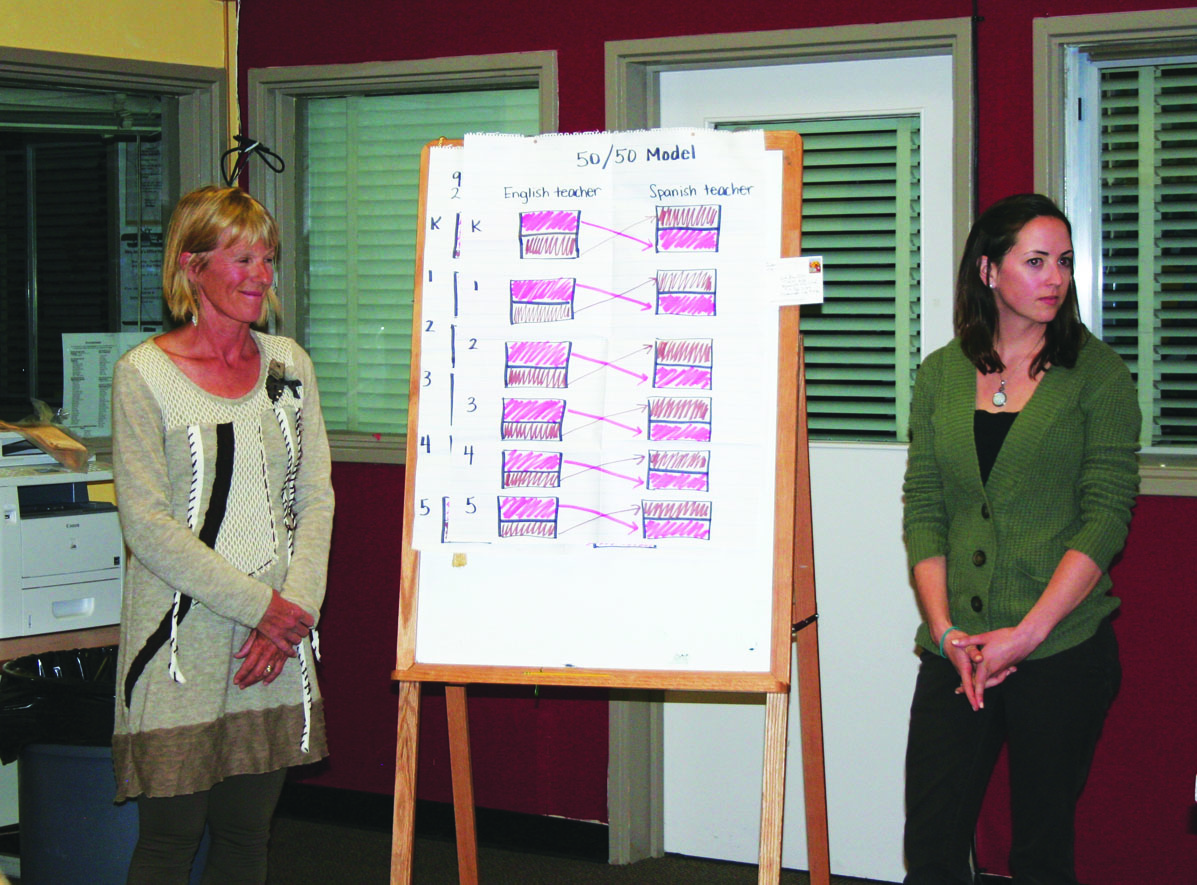
Second Grade Dual Immersion Teachers Emily Underkoffler (left) and Melissa Mullen explain Mammoth Unified School District’s current 50-50 program, and the upcoming change to a 90-10 and “FLOW” program. Photo courtesy: Vane.
Meanwhile Klein explained that a 90-10 approach will allow students to learn to read in one language. “If you learn to read in one language, it makes it easier in another,” she said.
The second proposed program was more controversial among parents. “FLOW” (Foreign Language One Way) would start with 90 percent English, rather than 90 percent Spanish, and progressively add more Spanish until achieving 40-50 percent in each language by fifth grade. Students would conclude the program with functional Spanish and full literacy in English.
“Many of the teachers felt that [FLOW] would be beneficial to the English Learners,” said Glende.
As for students already enrolled in the District’s 50-50 program, Dual Immersion Second Grade Teacher Melissa Mullen said these students would receive an “enhanced program.” Klein said the District will make the 50-50 program “the best that it can possibly be,” bringing it closer to 50-50 than it has been.
Parents surprised by the news of the program change were even more concerned about the May 20 deadline for deciding in which of the two new programs to enroll their children.
Several parents wondered whether their children could get into the program at all, considering those who already have children in Dual Immersion, and MUSD staff, get preference.
For those who do get their children into the 90-10 or FLOW programs, “My concern is that the kids will be going to school with the same 20 kids only,” said Chelsea Nash. Currently, students can move between the two 50-50 Dual Immersion classes, but with the change, they’ll be constrained to only one. “Right now the kids are already segregated,” Nash said; “they don’t know anyone outside of Dual Immersion.”
Fourth Grade Teacher Michelle McMillian expressed her concern that these small classes might get even smaller through attrition. Others worried that the FLOW program, which would only create “functional” bilingual speakers, is more of a language class than a Dual Immersion class. These parents argued that the District is essentially cutting its Dual Immersion offerings in half, and wondered why MUSD wouldn’t pursue two 90-10 classes. Superintendent Klein said the District didn’t have the staffing.
“I was completely befuddled when I learned this was happening,” said Eighth Grade Teacher Jill Orozco. She alluded to the long road the Dual Immersion program has traveled to get where it is, including its share of controversy in the first years of the program, when “[Students’] education was spotty at best.”
Orozco argued the program has changed significantly, and that it now brings together students from white and Hispanic communities in a way seldom seen in the Mammoth community.
“I don’t believe that we should give up on the program that we’ve worked so hard to sustain,” agreed Lara Walker.
Concerning to the Board of Education was whether or not the Board ought to have approved the change in Dual Immersion program, as the Board approved the original Dual Immersion program. Superintendent Klein argued that “this is procedural, so it really isn’t policy,” and therefore didn’t have to be approved by the Board. She said the Board and District would determine whether the change requires a vote by the end of Thursday, May 14.
In a follow up interview with The Sheet, Klein said the District would be slowing down the timeline so that parents don’t have to make a decision next week about their children’s’ enrollment in Dual Immersion.
“We are going to have the meeting next week, but we’re going to spend time talking about the pros and cons of both programs, giving parents more opportunity to ask questions of teachers, and more time to think about it,” she said.
The District will eventually allow parents to rank their preferences for the 90-10 or FLOW program, and will go to a lottery system for those on the waiting list, although many parents worried that few if any spaces could be available in 90-10 once those with preference take their pick.
Superintended Klein said the process was moving so quickly because of the District’s timing in hiring Joanna Junge as a consultant. MUSD hired Junge in the spring.
“We’ve been listening to parents, teachers, and students express that frustration,” Klein said. “There definitely are some kids that have been successful, but there are way too many kids that should be able to be successful that have been struggling. We’ve been wrestling with that, hearing the teachers, looking at the data, and then I was out looking for an expert to bring in.”
Regarding the change in program, she said, “When we know there is a better option out there for the kids, it is our duty to do the very best for our kids.”


