
The Sheet year in review: headlines
A year in resignations
Mammoth Mountain Ski Area COO Greg Dallas resigns in August. Dallas had been with Mammoth 14 years.
“Greg has done the impossible during impossible times, leading Mammoth to profitability despite a string of record setting droughts and declining skier visits. His talent and intensity will be missed,” says MMSA CEO Rusty Gregory of Dallas’ departure. Mark Brownlie, formerly VP of Mountain Operations, is promoted to COO.
The Eastern Sierra Tri-County Fairgrounds asks Fairgrounds CEO Sally Symons to resign after its Board meeting on September 4. For more on why, see next page.
Controversial Northern Inyo Hospital CEO Victoria Alexander-Lane departs on September 14. Anecdotally, the general morale at the hospital has been described as poor to dismal. More than 70 employees were canned or walked out during Lane’s 18-month reign, according to hospital sources.
Lane says that her departure “really was a mutual agreement.” She says the board and the hospital has “taken a lot of abuse” and that a change might help get the hospital back on track.
Next, Southern Inyo Hospital’s CEO, Lee Barron, resigns on December 14. Southern Inyo Hospital has been struggling to pay the bills, to keep the lights on and its doors open. The hospital is forced to close its Emergency Room on Dec. 3 due to a lack of funds. Nurse Practitioner Donna McAuley from the hospital’s Rural Health Clinic is appointed acting CEO.
A year in drought
First, water restrictions tighten in Mammoth Lakes, when the Mammoth Community Water District (MCWD) Board votes on April 1 to increase its Water Restriction Level from II to III. Level III Restrictions go into effect on April 10.
In Mammoth, a 30 percent decrease in water use could save 150 million gallons in 9 months, compared to usage in 2013.
MCWD GIS Specialist Betty Hylton describes the increase in Water Restriction Level as the result of a recent snowpack survey at Mammoth Pass that found only one inch of water, or about 2 percent of average.
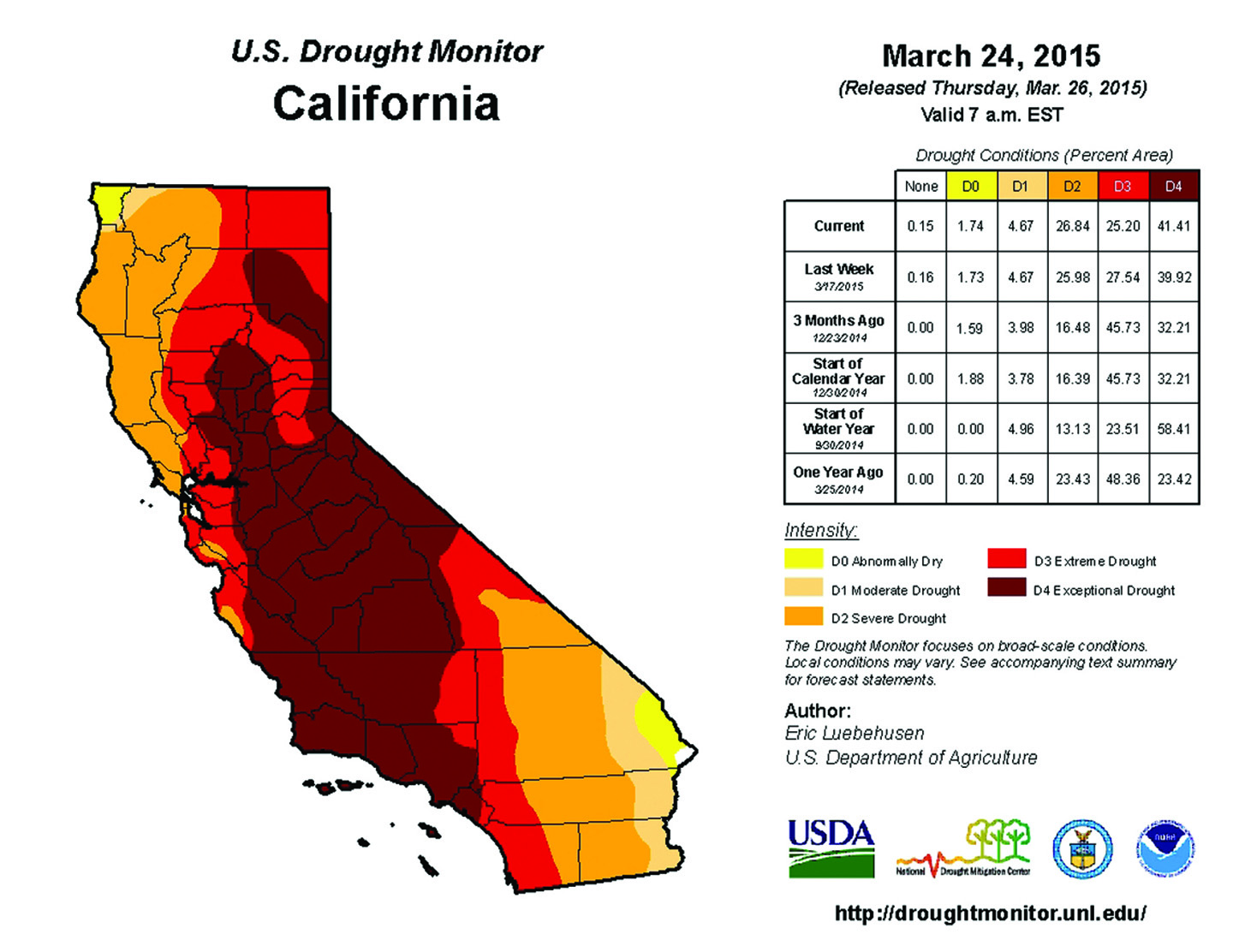 “It’s the lowest year on record,” Hylton says.
In reaction to the historic fourth year of drought, the Los Angeles Department of Water and Power (LADWP) begins diverting water from the Mono Basin with the intent of taking the entire year’s allotment by the beginning of May. This will drop the Grant Lake of May. This will drop the Grant Lake Reservoir level by six feet before summer even starts.
The Mono Basin snowpack measures at 14 percent of average on the first of April, which translates to a 19 percent of average runoff forecast for April through September as the snow melts. 22 percent is the runoff forecast for Rush Creek specifically.
Mono Lake Committee Executive Director Geoff McQuilkin says the largest issue isn’t diverting the water but the timing of that diversion, which could adversely affect summer boating and recreation at Grant Lake, and potentially the Rush Creek Fishery.
The LADWP doesn’t make any more friends when in late April it proposes cutting cutting Owens Valley irrigation allotments by 66 percent, from a typical average of about 49,000 acre-feet to just 16,500 acre-feet.
LADWP Aqueduct Manager Jim Yannotta says that April to September runoff is anticipated at only 25 percent of average. These kinds of lows “haven’t occurred since the aqueduct was in the Valley,” says Inyo County Water Director Bob Harrington.
As a result, the LADWP does not export any water from the Owens Valley for the first six months of the runoff year. Nevertheless, the LADWP’s proposal to cut irrigation allotments by 66 percent meets with fear and anger.
In the following months, Inyo County and the LADWP work out a number of changes to ensure that in-valley water use will be redistributed to help agriculture survive.
Between ramping down the water used for dust mitigation on Owens Lake early last spring, and delaying the ramp up of water to the lake this fall, the LADWP saves about 10,000 acre-feet that will now go toward irrigation. The LADWP will now allocate 39,629 acre-feet.
“Normally they would irrigate about 49,000,” Harrington said. “Given the runoff conditions, a 20 percent reduction in irrigation seems pretty livable, so that was good news.”
By the end of the year, California’s four-year dry spell has lowered the levels of Mono Lake to an almost unprecedented level.
“We’ve seen the lake go down more than 5 feet now over the last four years,” says Mono Lake Committee Executive Director Geoff McQuilkin. “The good news is if we hadn’t won that protection for Mono Lake back in 1994, it wouldn’t have gone up to the point that it was survivable. It would pretty much be ‘game over’ for the ecosystem of Mono Lake.”
The 1994 decision decreed a threshold of 6,377 feet—any lower, and Los Angeles would be forced to stop diverting any water from Mono Lake’s tributaries. The lake’s current level of 6378.2 feet is pushing close to the threshold, leaving L.A. facing a water export of zero. The city has not faced this situation since the rules were imposed.
If the lake does not drop below the crucial threshold this coming April, L.A. will export 4,500 acre-feet of water from the Mono Basin—the maximum allotted by the Water Board when lake levels are under 6,380 feet. “However, if the lake elevation on April 1 is at or above 6,380, exports will be 16,000 acre-feet,” says LADWP spokesperson Amanda Parsons.
A year on the wrong side of the law
Edgar Weaver, 31, of Mammoth Lakes is sentenced to four years in state prison on Sept. 21 for his role in the October 6, 2014 death of Becki Dempsey in a motorcycle crash.
An intoxicated Weaver, with Dempsey as passenger, lost control of his bike on the tight corner heading up to Eagle Lodge on Meridian Blvd. by Meadowridge Condominiums. It was estimated he was traveling at approximately 75-80 m.p.h. in a 40 m.p.h. zone.
Both were thrown from the bike. Dempsey died of internal injuries. Dempsey, 21, a native of the United Kingdom, had only been in Mammoth for a few months.
Weaver pleads guilty to Gross Vehicular Manslaughter. Judge Stan Eller sentences him to four years in State Prison. He also orders him to pay approximately $35,000 to the victim restitution fund.
In October, Mammoth anesthesiologist Jonathon Bourne pleads not guilty to 21 felony counts that include alleged looting, possession and transportation of Native American artifacts. Bourne is arraigned in U.S. Federal Court, Eastern District of California in Fresno on Oct. 5. If found guilty, Bourne faces a maximum of 98 years in prison and a $2 million fine, according to a press release from U.S. District Attorney, Benjamin Wagner.
Federal Agents searched Bourne’s Mammoth residence in December 2014 and found more than 30,000 artifacts including points, pendants and mortars, or metates, along with detailed logbooks describing his many digs.
Bourne has been an independent contractor at Mammoth Hospital for more than 30 years and will continue to work there “indefinitely” or until he is unable to, hospital CEO Gary Meyers says in an email to The Sheet.
The Intertribal Court of Southern California Court of Appeals throws a wrench in the Paiute Palace Casino expansion project works with an opinion filed on Nov. 2. The court rules that Bishop Paiute Tribe member Geraldine Pasqua has sole right to occupy and possess the two lots of land the Tribal Council has long included in its casino expansion plan.
The proposed $30 million dollar expansion project includes 94,230 square feet of hotel, casino floor and meeting/conference space, according to the August Bishop Paiute Tribe’s Tribal Newsletter. The hotel would be two stories, 80-100 rooms, while the casino itself would expand an additional 10,000 square-feet, with three floors total, and would connect to the hotel. The estimated completion date is mid-year 2017.
Tribal Council Chairman Gerald Howard disagrees with the Court of Appeals decision. “We’re going to seek a re-hearing on this,” he says. “I’m just kind of astounded at the decision, and frankly, that the decision wasn’t left in the hands of the Tribal Council … With any court, the tribal sovereignty issue is there in determining the best interest of the Tribe.”
Following a five-month investigation by the California Highway Patrol (CHP), the Inyo County DA charges former Fairgrounds Chief Executive Officer Sally Ann Symons with three felony charges, including misappropriation of government funds, embezzlement of government funds, and grand theft.
Symons voluntarily surrenders herself on Nov. 30 to the DA. She is booked and is out on a $25,000 bond. She is scheduled to appear in Inyo County Superior Court, Bishop for an arraignment on January 6.
Symons has not publicly admitted to the charges. Rumors are she allegedly took about $9,000 from an onsite ATM. If found guilty, Symons faces a maximum penalty of four years in prison. District Attorney Tom Hardy says given Symons’ prior history and arrest record, “It seems fairly unlikely” the maximum penalty will be imposed.
Another local case of embezzlement is finally brought to a close in Independence in November as Delores “Lola” Marsh, a former employee of the Inyo Mono Body Shop, pleads guilty before Superior Court Judge Brian Lamb to one count of grand theft and one count of forgery. Under a plea agreement, she agrees to accept a sentence of two years in the Inyo County jail and pay $322,000 in restitution to the business where she worked as a trusted bookkeeper for many years.
The guilty plea comes after an investigation by the Bishop Police Department which was initiated in early 2013, examining records going back as far as 2005. Marsh was officially arrested and charged in February of this year on five counts of grand theft, five counts of forgery, and altering entries in books and records. She pleads guilty to making purchases from Target in excess of $46,000 between December 2009 and April 2013. Other charges are dismissed under the plea agreement. Marsh remains free on $50,000 bail until sentencing in January.


