
Probing the Cosmic Dawn
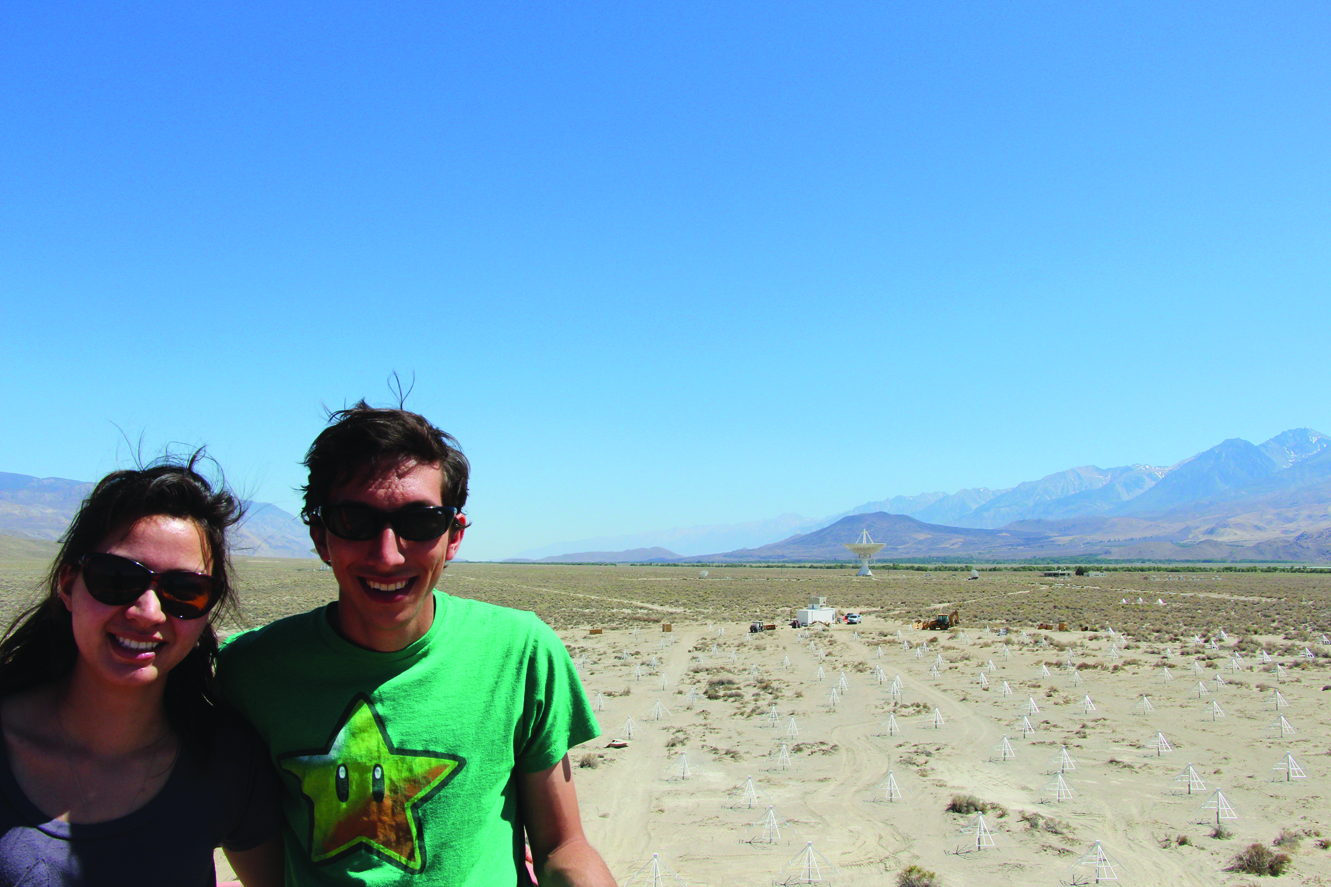
A short history of the universe with Caltech graduate student Michael Eastwood
Researchers at the Owens Valley Radio Observatory hope that their telescope will allow them to be the first in the world to observe the origins of the universe’s first stars. On Thursday, November 9, Michael Eastwood gave a presentation on that research, called “A History of the Universe: 13.8 Billion years ago Today.”
Eastwood, a graduate student at the California Institute of Technology, is studying the origins of the oldest stars in the universe from the Owens Valley using the Owens Valley Long Wavelength Array. He grew up overseas, then got his B.S. in physics at Rice University in Texas. His interest in astrophysics brought him to the Owens Valley, where he is conducting research for his doctoral thesis, which he plans to finish next year.
Five years ago, he and other graduate students assisted with the construction of the array, which is comprised of 256 antennae spanning a distance of 450 football fields in the Owens Valley. The array was constructed by a consortium of astronomers from Caltech, NASA’s Jet Propulsion Laboratory, Harvard University, The University of New Mexico, Virginia Tech, and the Naval Research Laboratory. The array is especially good at detecting faint radiation left over from the beginning of the universe. That radiation was previously difficult to detect because it was drowned out by the massive radiation emitted by bodies in our own galaxy.
Eastwood’s research is predicated upon the fact that the universe is constantly expanding. As such, light appears to stretch as it moves from the furthest corners of the observable universe towards earth. Light takes time to travel across space—it doesn’t just happen instantaneously. Since what we see is dependent upon objects in the sky emitting light (and in Eastwood’s case, radio waves), we see distant objects as they were in the past, and when astronomers study distant galaxies, they are studying them as they were in the past. It is therefore possible, if you can see far enough away, to observe the earliest moments in the universe’s history.
Where powerful optical telescopes such as the Hubble telescope capture images of the universe using optical light, radio telescopes capture images using radio waves. According to Eastwood, certain wavelengths of light are better than others for observing different parts of the universe. Different objects emit different types of radiation. Long wavelength arrays detect radiation that has a lower frequency and is therefore especially useful for detecting objects that are so far away that the radiation they emit appears stretched due to the constant expansion of the universe.
Eastwood’s goal is to observe the gas bubbles that were created when the first stars ignited. These bubbles release long wavelength radiation that tends to be “choppy,” in part because they tend to emit lots of hydrogen. Stars formed later in the universe’s history tend to generate gas clouds comprised of heavier metals, which tend to emit radiation with different characteristics. According to Eastwood, much of the long-wavelength radiation produced within our own galaxy is relatively “smooth” in frequency. It’s Eastwood’s goal to find a way of reliably distinguishing between the choppy signals emitted when the first stars turned on and the smooth signals emitted by closer galaxies and objects.


