
Playing hooky for gold
“Manzanar Fishing Club” screens at Lone Pine Film Museum
They snuck out in the dead of night, or sometimes in full daylight, in small groups, pairs, or alone. They crept up creek beds to the foothills of the mountains, or even crossed over into the backcountry, returning with strings of golden trout and Colorado River cutthroat trout.They were internees at Manzanar War Relocation Center.
This Saturday, “The Manzanar Fishing Club,” a film directed by Cory Shiozaki and written by Richard Imamura, will illuminate this little known piece of Owens Valley history. The film will be shown at the Lone Pine Film History Museum as part of the Eastern California Museum and Metabolic Studio’s “100 Conversations About Water” series commemorating the 100-year anniversary of the Los Angeles Aqueduct.
The film will screen at 7 p.m. and is free to the public. The filmmakers will be on hand for a post-film discussion.
Shiozaki and Imamura’s film presents the story of those internees at Manzanar who tasted freedom when fishing in the high country streams and lakes of the Eastern Sierra. The film includes interviews with internees who pursued this pastime despite threat of punishment or even death.
Director Shiozaki is an avid fisherman whose parents were among the 120,000 Americans of Japanese descent confined in 10 Relocation Camps for the duration of WW II. His inspiration for the film came from a photograph in the Los Angeles Times’ Trout Fishing Opener story in 2004. The photograph was of an elderly Manzanar internee holding up a string of golden trout.
“Golden trout live at a higher elevation, and are not found at the plains where Manzanar was,” Shiozaki explained. Intrigued, he decided to visit Manzanar to ask about the photo. Upon learning that there was more to the story, Shiozaki embarked on what would become an eight-year project.
“I’ve been a cameraman for about 25 years or so,” he said. “I always wanted to do a documentary about Japanese American internment, mainly because it’s the story my parents never told me.”
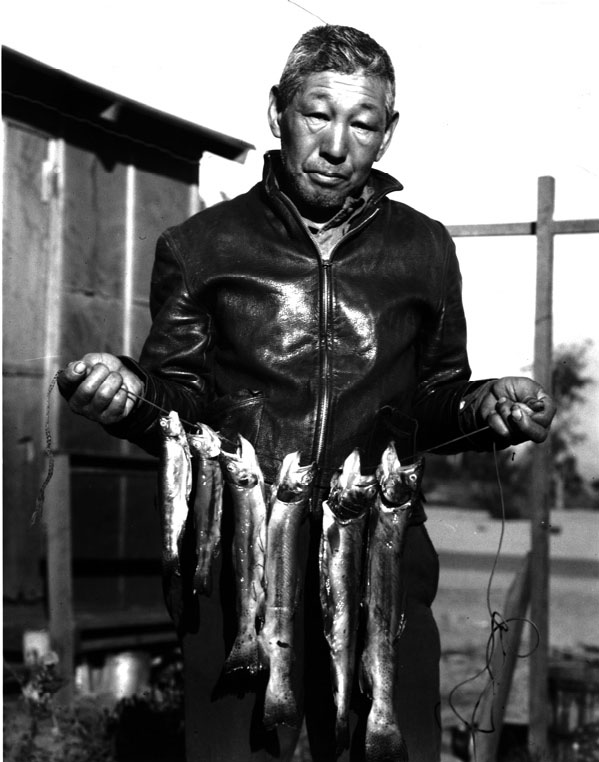
Heihachi Ishikawa, the inspiration for the film.
Over the next several years, with full cooperation from the Manzanar National Historic Site, Shiozaki collected oral histories from 12 internees who had escaped the camp during their internment to fish. Shiozaki said he believes that at least a hundred, if not several hundred of Manzanar’s 10,000 internees, participated in this covert activity.
Writer Imamura noted that internees had several different methods of escape. Some internees chose to sneak out under the barbed wire at night, dodging the searchlights until they could reach the brush near dry streambeds. The dry streams “created gullies like trenches,” Imamura explained.
Other internees would sneak away from their work crews while out cleaning debris from Shepherd Creek. “They would just take their fishing poles with them,” Imamura said. Their supervisors would look the other way, he added; they were also internees.
Still others would use the most novel form of escape: concealment in clean garbage cans that were taken by an internee supervised trash crew to the dump outside of camp.
Some internees would creep up a creek and wait until dawn before fishing their way back, Imamura said. Heihachi Ishikawa, whose photograph first captured Shiozaki’s imagination, would stay out in the backcountry for up to two weeks.
At the time, Ishikawa was 53 years old. “Fishing meant that much to him, that he went by himself,” Shiozaki said.
“There were numerous fellows who got caught,” Imamura said. The worst punishment: a stint in the Manzanar jail for one day to a week. Another punishment was a fine of a month’s wages, about $12-$16. Imamura also noted that Manzanar guards deliberately shamed younger internees upon discovery. Guards would handcuff these internees and lead them back to camp at bayonet point.
“Some quit,” he said, “but many went out after that anyway.”
Imamura described the Manzanar Fishing Club story as the story of freedom. “[Internees] lost everything they had in the city; they ended up in a mile square compound, far from everything. Few of the internees had any experience living in the high desert. In all respects, it was a prison camp.
“I think one of the fellows summed it up best when he said, ‘The air just tasted better outside the wire.’”
The film premiered at Manzanar in 2012, and has since shown in Bishop and Mammoth.
The filmmakers are now looking to turn the film into an educational package. “One of our goals from the beginning has been to spread the story of internment, because it’s not really covered that thoroughly in schools,” Imamura said. “


