
In Bhutan, they measure GNH
PNB is the only international airport in the small Himalayan country of 750,000 citizens.
As we began our descent into Paro, I braced myself for the inevitable turbulence I expected after frequent flights in and out of Mammoth Yosemite Airport, which is located at similar altitude and has comparable mountainous weather conditions. I was pleasantly surprised when the wheels touched down on the tarmac without so much as a bump.
Landlocked Bhutan is surrounded by India to the south and the Tibetan region of China to the north. Unlike nearby Nepal, Bhutan has been slow to open to the outside world. The government first allowed television the same year as the Internet (1999). The first tourists were allowed in 1974 and tourism is the major economic base even though only approximately 115,000 tourists visit the mountain kingdom each year. Visas are required for every nationality, except India, and every tourist has to travel as part of a pre-packaged tour offered by one of the roughly 300 tour agencies in the country.
Bhutan boasts more than 15 mountain peaks over 20,000 feet. The tallest peak is close to 25,000 feet, although foreigners are not allowed higher than 19,500 feet because of the national Buddhist belief in the sacredness of the high places.
The country was never colonized and was ruled by a family line of kings until becoming a constitutional monarchy in 2008.
The current king, Jigme Khesar Namgyel Wangchuck, is known for the national motto, “happiness is a place”; his policy of Gross National Happiness (GNH) is rooted in the nation’s long history of Buddhism. GNH is “meant to orient the people and the nation towards happiness, primarily by improving the conditions of not-yet-happy people,” according to the government website.
How this policy is actually measured or implemented isn’t clear.
After the smooth landing and easy immigration process, watched over by a life-sized portrait of the king, my dad and I walked outside into the crisp mountain air. It was before 7 a.m. and the airport was virtually deserted, making it easy to find our tour guide, Denzin.
Stray dogs were the only sign of life as we drove through Paro to our hotel. Surrounded by national forest and complete with its own mountain spring water source, Naksel Boutique Hotel boasts views of Paro Valley and 24,000-foot Mt. Jumolhari, which separates Bhutan from neighboring Tibet.
My dad serves on the Board of Directors for Naksel as part of his work at Global Network, an Orange County based development NGO (non-governmental organization). The hotel is located in the small village of Ngoba, just five miles from Paro. The village is made up of roughly 50 households, whose residents work in their rice paddies and the currently blooming apple orchards. The village has benefitted from the building of Naksel, as the hotel has brought business and road access to Paro.
A long-time sufferer of motion sickness, winding, bumpy roads were inevitable if I ever wanted to leave the hotel. We traveled between Paro and Thimphu, the capital, but it was difficult for me to enjoy the astounding mountain scenery along the main road, which follows a river along the edge of steep mountain cliffs. Our driver assured me this road was better and much faster than the narrower dirt road that used to run between the two cities.
It didn’t help that I was constantly nauseous and unable to hold any food down for the first three days. Denzin insisted I was just experiencing altitude sickness, and needed to keep eating.
Those first few days, I took brief tours of local dzongs, ancient fortresses now operating as monasteries and governmental centers, with Denzin, while my dad had meetings. Walking around the Thimphu, I felt slightly out of place in my western clothes, surrounded by locals in traditional dress. Men wear the Gho, a knee length robe tied at the waist that resembles a kimono, and women wear long skirts and silk jackets. Denzin wore his own brightly colored Gho everyday, explaining it is required by law to conduct any type of formal business.
All of the architecture in Bhutan is required by law to mimic the ancient dzongs: a mix of elaborately painted rammed earth and intricate carpentry.
The main intersection in Thimphu, adjacent to the town square, is manned by a police officer with white gloves and a whistle directing traffic from the traditionally built wooden booth situated in the middle of the intersection. The city had a stoplight for several months, but it caused too much confusion and the electricity kept going out, according to Denzin.
I joined my dad for meals (that I couldn’t stomach) with Sonam, the developer and owner of Naksel. Sonam is a short, graceful woman in her early sixties, full vision and passion for her country. In addition to Naksel, she operates Rainbow Tours and Treks, rated among the top 10 agencies in Bhutan. She also recently started the Keshet Foundation.
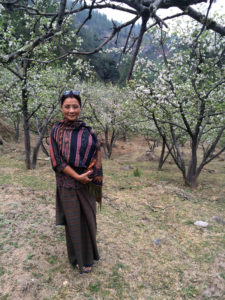
Sonam, founder of the Keshet Foundation, which treats drug an alcohol addiction in Bhutan.
There are less than 40 registered non-profits in Bhutan, and Keshet is the first one dedicated to drug and alcohol addiction rehabilitation and prevention. Statistics regarding the substance abuse in Bhutan are hard to come by, but Sonam shared several stories of the pain and devastation it has caused.
The mission of Keshet is to provide rescue services for youth and their families who are caught in destructive world of substance abuse. Sonam, who has family members struggling with substance abuse, started the foundation last November with funds from her businesses, and is hoping to raise more funds in order to build a detox center on property she already owns outside of Thimphu.
In addition to whatever bug was haunting my stomach the first few days, Paro Valley was also engulfed in a haze created by several forest fires burning in the far east of the country. Fortunately, rains came and cleared the air, making the breathtaking views from Naksel fully visible for the first time.
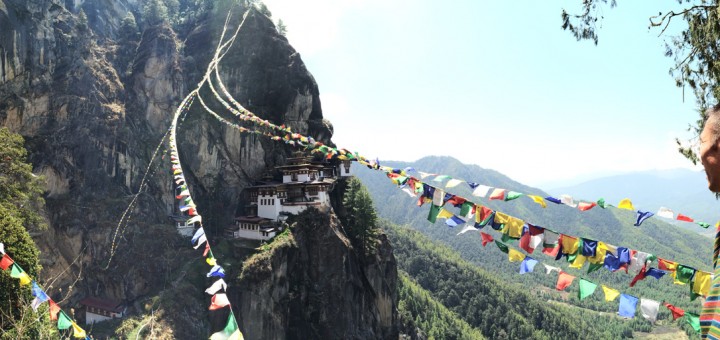
The air cleared just in time for our hike up to Tiger’s Nest, or Taksang, an ancient temple and monastery located mid-cliff, at 10,000 ft., above Paro Valley.
The monastery was built in the 17th century and is named after the myth of Guru Rinpoche, who is said to arrived at the cave on the back of a flying tigress to fight a demon in the 8th century. After his victory, the Guru is believed to have meditated there for three months and the present monastery is built around the cave.
Denzin tried to convince me to ride a horse for the first two thirds of the trail before the steps, insisting the hike would be too difficult for me. In the end, he persuaded my dad to hire an extra horse for me, which I never rode. The small Asian horses climb the mountain once a day, following along the very outer edge of the trail, dangerously close to the steep drop off. They are so familiar with the trek that they don’t take direction from their riders, making the trail somewhat of an obstacle course for hikers walking on the same trail.
The trail is surrounded by a thick forest of blue pine and rhododendron trees and splashed with colorful prayer flags. At times the strings of flags cross the path at head height, giving hikers the sense of walking through the actual prayers themselves.
With a 1,500-foot elevation gain, the hike is roughly three miles and takes the average tourist almost two hours to climb. Two thirds of the way up, the dirt trail morphs into a well-built stone walkway. This is where the horses stopped, along with a group of older tourists who sat at an overlook but did not continue to the monastery.
From here, we climbed down roughly 400 steps before crossing a waterfall on a narrow bridge, and climbing 400 steps back up to the monastery itself. After handing over cameras, backpacks and even our water bottles, we were all individually frisked by Bhutanese police officers before entering the monastery complex. We toured several small temples covered in colorful paintings of Buddha and the Guru, encountering an older smiling monk dressed in red robes and offering blessings to tourists.
The hike down the mountain was breathtaking, with expansive views of Paro Valley and numerous mountain peaks. Tiger’s Nest, with the surrounding scenery, is unique and well worth the effort it took to get there.
The same can be said for the Kingdom of Bhutan.


I just returned from Bhutan a week ago, stayed in Naksel, trekked atop tiger hill. I can relate so much with your article. A very well written piece indeed.