
Silver lining in the fire
Dr. Chad Hanson, Director of the Earth Island Institute John Muir Project, offered a surprising perspective at the second Sierra Nevada Aquatic Research Laboratory (SNARL) lecture on the ecological benefit of forest fires.
The lecture was held Tuesday night at the Green Church at the intersection of Benton Crossing Road and Hwy. 395.
While most would consider forest fires to be dangerous and destructive, Dr. Hanson argued that they give rise to some of the most biodiverse habitats in the Western U.S.
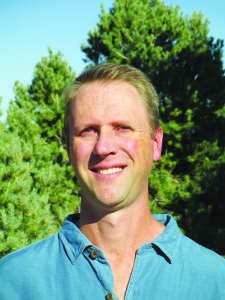
Dr. Chad Hudson.
“Fire is not destructive,” Dr. Hanson opened his lecture; “it is a natural force in the Sierra.”
If left to natural regeneration, areas where high-intensity fire has killed 75-100 percent of trees “are comparable to old growth forest” in terms of biodiversity, Dr. Hanson said. In his studies he has seen the natural regeneration of conifers and vegetation, which in turn attracts a diverse array of animal species.
Yet these “snag” forest habitats are even rarer than old growth forests, and have none of the state or federal protections.
According to Dr. Hanson, snag habitats have declined by more than fourfold in the Sierra Nevada since the early Twentieth Century because of fire suppression. Another threat to these habitats is the commercial thinning of forests, as well as post-fire salvage logging.
Dr. Hanson used last year’s Rim Fire as an example of the benefit of fire, and the potential loss of that benefit because of thinning and logging.
From August to October, the Rim Fire burned 257,000 acres across Tuolumne and Mariposa Counties, involving about 5,000 firefighters and flooding nearby communities with smoke.
Although the media quickly latched on to dramatic satellite imagery of the fire, giving the impression that much of the affected area would be reduced to nothing but ash, Dr. Hanson said that only 33 percent of the fire qualified as high-intensity, and that the largest high intensity fire patches were only a few thousand acres. Even these areas rarely demonstrated 100 percent tree mortality, Dr. Hanson said.
The heterogeneity inside these high intensity areas has allowed for the creation of a uniquely diverse habitat.
Dr. Hanson pointed to the Black-backed woodpecker as one species that flourishes because of burned areas like those created in the Rim Fire. The Black-backed woodpecker is “very strongly dependent upon recent burned habitats,” he said.
Three-toed, barb-tongued, and equipped with air pockets to cushion its brain when it pecks into burned trees seeking wood-boring beetles for food, the black-backed woodpecker requires roughly 200-400 acres of burned snag forest to thrive.
“Post-fire logging destroys that habitat,” Dr. Hanson said.
The Black-backed woodpecker isn’t the only species that stands to lose valuable habitat because of state and federal fire management practices, he added. Snag forests also allow post-fire flowering shrubs to grow, attracting birds, butterflies and bats. Small animals are abundant in these same areas, Dr. Hanson said, providing food for the endangered California spotted owl and Pacific fisher, among other predators.
Even native fish species have flourished where fire debris flows have occurred, he said, with greater numbers of Bull and Cutthroat trout observed one to three years after a fire burns.
While fires tend to be described as ‘catastrophic’ or ‘devastating,’ “Actually,” Dr. Hanson argued, “[snag forests] are ecological treasures.”
Yet in the wake of the Rim Fire, the USFS is proposing a similar strategy to that which was adopted after the last significant fire in 1987. After the 1987 fire, the USFS allowed timber companies to log the dead trees, and replanted new trees in their stead. The USFS also practiced the policy of “thinning” forests to reduce potential kindling.
What this does, Dr. Hanson said, is “simplify the system. It creates live medium and large trees, and not much else. You need logs, chaparral, and undergrowth.”
During the Rim Fire, “long unburned forests burned at lower levels of high intensity than mechanically thinned areas,” Dr. Hanson said.
Ironically, those areas had been thinned by the U.S. Forest Service (USFS) with the aim of reducing fire fuel.
“The fire did not devastate this area, but the post-fire logging did,” he said.
The issue with this is twofold: on the one hand, by proposing to salvage logs and replant about 45,000 acres affected by the Rim Fire, the USFS is potentially creating an even worse fire hazard than would exist if the area were left to regenerate on its own. On the other hand, those 45,000 acres “represent a huge portion of the [potential] snag forest,” Dr. Hanson said.
He added that, because of an obscure salvage fund, the Forest Service keeps every penny of logging sales. “None of that goes back to the General Fund of the U.S. Treasury,” he said. “This creates a perverse incentive.”
Dr. Hanson noted that he and the John Muir Project work closely with the USFS to encourage them to preserve these unique habitats.
“This is one of those cases where they’re just not listening,” he concluded.


