
Yoga on water
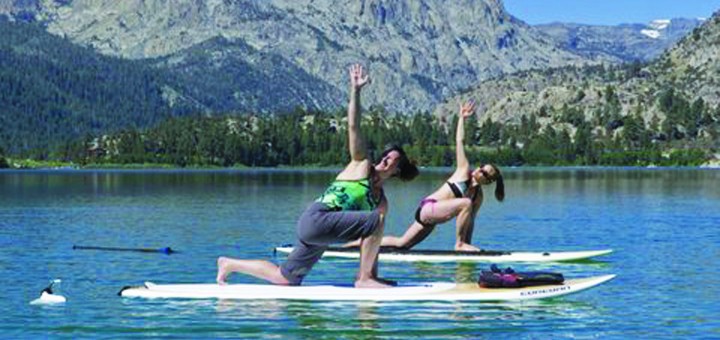
Lindsay McLaughlin mixes athletic mediums at June Lake.
Local yoga instructor Lindsay McLaughlin has been teaching since 2008, although she has been practicing yoga for much longer. “I had a life change in my mid-twenties,” she recalled. “I had partied a lot when I was younger … [Yoga] helped me get to know myself and get in tune with who I was. Basically it saved my life.”
McLaughlin, a breast cancer survivor, discovered stand up paddleboard (SUP) yoga while staying with her parents in St. Petersburg, Florida in 2011. She took a four-day certification course that covered paddleboard basics and yoga technique.
She began teaching classes at June Lake every other week in 2012, increasing it to every week in 2013. This summer, McLaughlin teaches classes at June Lake on Sunday morning and at Lake Mary on Tuesday morning. McLaughlin works with Mammoth Kayaks at June Lake Beach and Pokonobe Resort at Lake Mary for $15 SUP rentals, and the class itself is $15. Classes are from 9 -11 a.m., although McLaughlin encourages people to arrive early in order to rent boards.
“Being out on the water and practicing yoga in that kind of space is so serene and it brings you into this peaceful place,” McLaughlin said. “It touches people on a different level than just practicing in a studio.”
But for McLaughlin, it’s not just about the scenery: “It’s a really good workout as well. It’s really good for the core and for balance,” she said. Plus, it’s fun. “You’re kind of like a kid again. You can playing around on the board and [if you fall] you’re just falling into the water.”
McLaughlin said that some people are afraid of the water and most do everything they can to not fall in. Which is how I felt when I met McLaughlin for a private lesson at Lake Mary.
“The warrior poses are really hard. The poses where you can take your feet wide or your hands wide, those are more stable,” she said. “One-legged balancing poses are just impossible. I’ve seen it done, but it’s hard.”
Although she has never fallen in during a class, McLaughlin falls in during her own practice.
“During the classes, we ease into it,” she said. McLaughin teaches people who have never done yoga, or who have never paddleboarded, or both. She also has help from Bryan Thomson, a regular at McLaughlin’s class and a paddleboard instructor who often assists beginners in the basics of the sport before the yoga class starts.
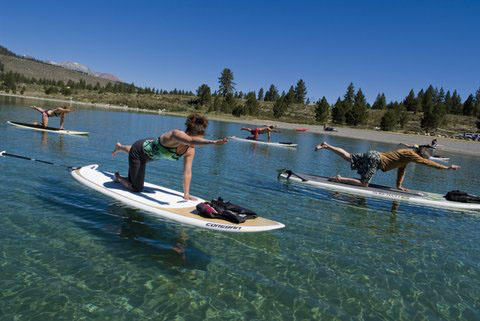
Paddleboarders do a yoga pose that no one in the Sheet office can name/identify. Photo courtesy: Bryan Thomson.
Thomson is a certified Master Level 1 instructor through the World Paddle Association (WPA). He has been paddling since 2003, “before boards had handles in the middle,” he said. As part of his certification with WPA, Thomson learned paddleboard techniques for recreation, racing, touring, whitewater, fitness, and surfing as well as water and ocean safety and basic lifeguarding.
“It takes five minutes to learn and years to master,” Thomson said.
Thomson said the sport is continuing to grow as people are using the boards for flyfishing and deepsea fishing and even Class 4 whitewater rafting. “That’s the coolest thing about it, there is yet to be something that we have not explored,” he said. “Even all of the diehard surfers that really hated us are now converting.”
Personal trainers are also offering more and more fitness classes using stand up paddleboards, taking their clients outside of the gym. Fitness director at Snowcreek Athletic Club Karrie McFadden is also an avid SUP user and fills in for McLaughlin from time to time.
McFadden started “supping” five years ago when a friend in June Lake gave her an old windsurfing board that she converted. Two weeks after purchasing her first SUP, McFadden raced in her first race—the 22-mile Fall Classic race around Lake Tahoe.
“I fell like a bazillion times, but I also fell in love with the sport,” McFadden said. “I had no idea what I was getting into. It’s in the middle of the lake and it’s like paddling in a washing machine.”
McFadden explained that east and west swells in the lake continually crash into each other, making supping much more difficult on Tahoe than it is on the lakes in our area. “Here in Mammoth we call ourselves flat water paddlers,” she said. “We’re all about speed, a narrow board, a high cadence. Of course good paddlers are good at everything.”
McFadden has continued to race in Tahoe and plans on competing in the Battle of the Paddle race off the coast of Dana Point this fall. Thomson, who helps McFadden train said, “She is climbing the ranks within the women.”
Next summer, McFadden and Thomson would like to organize a race to June Lake. “Having a race at June Lake would be perfect,” McFadden said. “It would bring the Bay Area people and the Southern California people. Supping is still a relatively small community and I know people will come from all over the country.”
She also suggested creating a waterman’s games that includes prone paddleboarding (surf paddling), outrigger canoes, and even grom races, which she has seen at other races. “It’s just a kick in the pants, watching these kids get out there and kill it,” she said. “Our skiers’ and snowboarders’ balance is already phenomenal from winter sports.”
After chatting for awhile on shore, McLaughlin suggested we get into the water before the wind picked up too much. As we took our time paddling out into the middle of the lake, I was acutely aware of the fishermen on the shore and surrounding us in boats. “I suggest people wear boardshorts and tanktops,” McLaughlin said. “Some people wear only their bathing suits … The fishermen get great views.”
We started with simple poses sitting down and moving onto our hands and knees, before trying some standing poses. “I can’t really be an alignment Nazi because of balance issues,” McLaughlin said as I tried to adjust a pose and almost fell into the cold lake. “Look at the shore or horizon for better balance,” she advised.
We had to stop the yoga practice a few times in order to paddle back out into the middle of the lake after the wind pushed us towards the shore. McLaughlin said that some classes use anchors to secure the boards while practicing yoga. “They will paddle out to the middle and then either have a single anchor they all tie off of, or individual anchors.” McLaughlin doesn’t use anchors, however, which causes people to drift apart or towards the shore. “We do more paddling this way,” she said.
After a while, I watched as McLaughlin effortlessly demonstrated a balanced headstand and then attempted one myself. I got as far as putting my knees on my elbows and decided to stop there instead of falling in the water. As I was upside down for those few brief moments, a family cruised by our boards in a pontoon boat. “Look, they’re doing yoga,” someone yelled. McLaughlin wasn’t fazed and said this happens often in her classes.
As we neared the marina, McLaughlin told me to prepare for shavasana. “It’s the best shavasana you’ll ever have,” she said. Shavasana is a relaxation pose at the end of most yoga classes, where participants lay flat on their back with arms and legs naturally resting against the mat or in this case the SUP. “Bring your arms out and feel the water on the back of your hands,” she instructed. “It’s just a really great way to connect with nature.”
McLaughlin has between five and twelve people in each of her classes and most of her clients hear about the class by word of mouth or through her website sierrayoga.org. In addition to the SUP classes, McLaughlin teaches at Snowcreek Athletic Club and at the Mammoth Creek Park on Wednesday mornings.


