
Mada Masr: A new approach to journalism in Egypt
It’s not often that writers become the story themselves. But in a country with constantly changing political landscapes and media laws, journalists who counter the status quo through honest reporting are worth noting.
After expressing my hope for the future of journalism in the October 17 edition of The Sheet, I spent the rest of my time in Egypt with the staff of Mada Masr, an independent English news website start-up based in Cairo.
According to their website, Mada “is the Arabic word for range, scope or span, but it’s also the spot where a stone is placed on a ring, a symbol of taking a position.” Masr simply means country, although it is often thought to mean Egypt itself. The staff at Mada Masr endeavor to provide unbiased reporting, while taking a firm stand against the media control in the country.
Chief Editor Lina Attalah called the news website “a child both of inevitability and crisis.” The crisis is obvious: in April of 2013, the entire editorial staff of the Egypt Independent, known for publishing critical, and at times controversial, content during the Egyptian revolution in 2011 as well as the following election of the Muslim Brotherhood in 2012, was let go and the paper shut down.
As an English language newspaper published through Al-Masry Media Corporation, the Independent had become a trusted news source during the revolution, especially among young students. The managers of Al-Masry insisted the decision to close the paper was due to financial concerns in trying economic times for print media. But the Independent staff found it hard to believe that politics weren’t involved.
By July 2013, these writers had reorganized and formed Mada Masr, just days after the military regained control of Egypt and eventually banned the Muslim Brotherhood.
“We are journalists who uphold very serious principles of progressive and professional journalism, but there is no institution [in Egypt] that can support that,” Attalah said. “There was an inevitability to building an institution where this dislocated practice of journalism can be housed again.”
In doing so, Mada Masr is seen by some as revolutionary instead of an impartial news source, as many of the young journalists were also activists in the revolution. But General Manager Amira Salah-Ahmed doesn’t see it that way. “The nation is polarized at a time of conflict and that’s a dangerous space to play in,” she said. “We are accused of being pro-Sisi [the former military General, now president of Egypt] and pro-Brotherhood in the same day.”
In some ways, the controversial place Mada has been occupying between these two distinct parties proves its staff’s impartiality—if both sides aren’t happy with the coverage, they must be doing something right. But creating a voice of dissention is a political stance in and of itself. “We’d be lying if we said we are a news organization that has no political direction whatsoever,” news reporter Heba Afify said. “We’ve had the revolutionary label automatically because of the way we have positioned ourselves between the main polarizing voices in Egypt.”
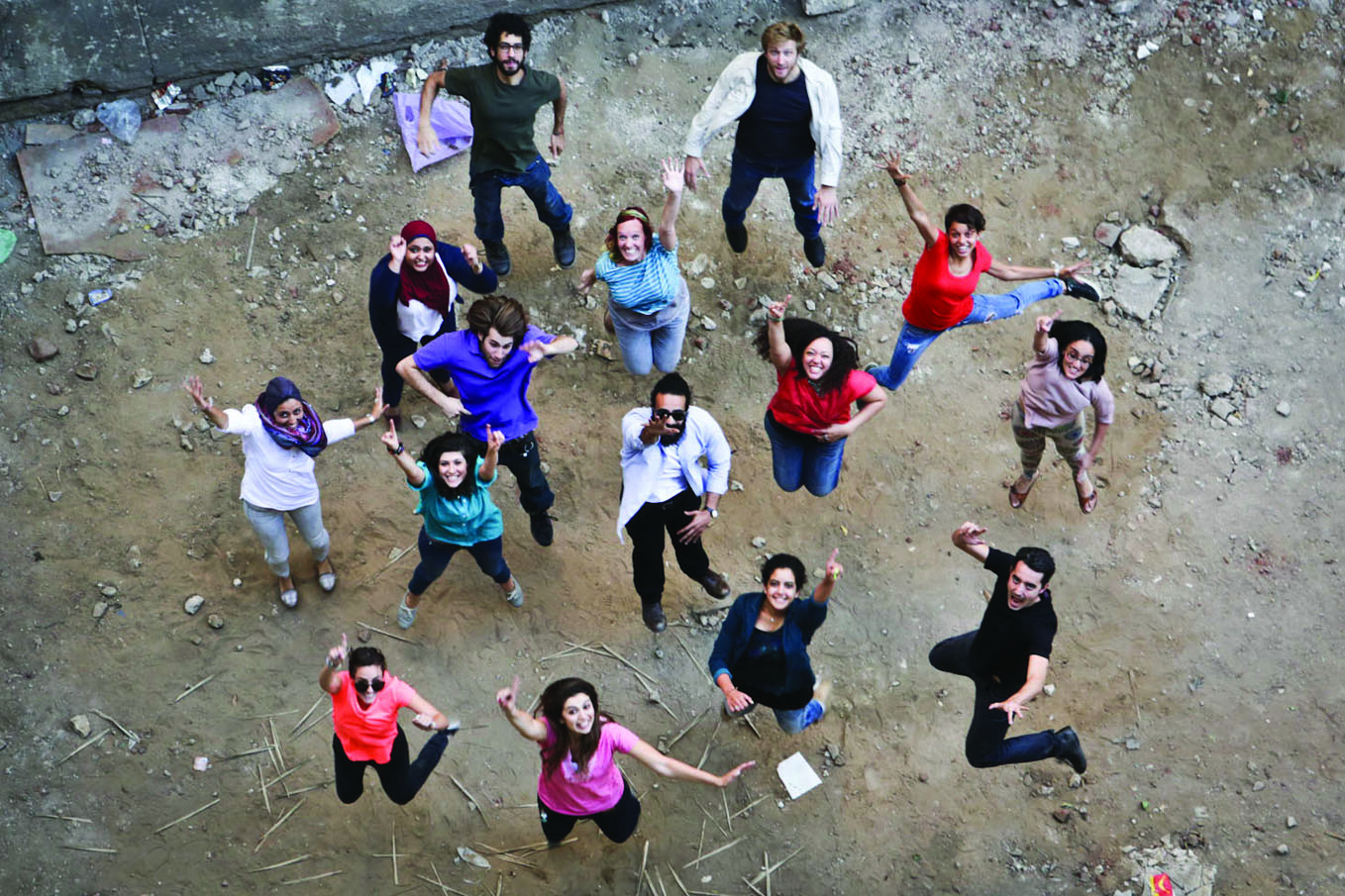
The Mada Masr staff celebrates its one-year anniversary in July of 2014. Photo courtesy: Mada Masr.
Listening to Attalah and other Mada staff, I became increasingly curious about the state control of media outlets in Egypt. The media market is liberalized and the private sector can invest and own media companies, Mada Masr being one of them. But the state owns the satellite companies, the printing presses, and even the main ISP address that all websites go through.
“The state controls the media through direct ownership of the infrastructural institutions that support it,” Attalah said.
And, at the same time, there is increasing consolidation of the news narrative in Egypt as state-run media and private companies publish the same headlines and stories. Many of the writers at Mada expressed concern over this encroaching universal voice and what it means for independent journalism in Egypt.
On October 26, shortly after I left Cairo, the Egyptian Editor’s Union released a declaration stating the members’ intention to support the government’s anti-terrorism efforts by refusing to publish any criticism meant to cast doubt on state institutions, the military, police, or judiciary.
Almost 600 journalists have responded to the editors’ declaration with their own statement rejecting the censorship of “public scrutiny or dissent,” calling it a “rule by one opinion” policy. Their letter, published in the Guardian, states that Egypt is currently one of the most dangerous countries to work as a journalist. Since the beginning of the revolution, 11 journalists have been killed and almost 70 journalists have been imprisoned since President Al-Sisi took control in 2013.
The team at Mada has received no direct threats, nor did they when working for the Egypt Independent. Attalah did, however, describe conversations with her superiors at Al-Masry asking her to think twice before publishing controversial content criticizing the government. “It was subtle intimidation that would cause you to self censor, as opposed to taking you and putting you in jail,” Attalah said.
Moreover, the general population has become more and more weary of journalists, making reporters’ jobs increasingly difficult.
“The government has managed to engineer this sentiment against all dissident media,” Attalah said. “My own journalists have been talking about how they find it harder and harder to work out of the streets and what’s journalism if you’re not out there?”
Around the world, local news agencies in general are hard-pressed to sustain a profit and stay afloat. In this economic environment, the staff at Mada have all adapted to managing several different titles within the organization, while continuing to contribute to the online content.
To sustain the company financially, they have introduced several subscription-based services, such as the Mada Morning Digest and a membership program that provides discounts to local restaurants and other businesses. Mada also offers contract-based editorial services for extra cash flow and sells advertising space on the website. And they are organizing events in order to “get readers more connected,” drawing them into a community that will hopefully later support Mada, said Salah-Ahmed.
In truth, they are looking for any way to bring in revenue to maintain both the website and the editorial staff. They are also hoping to attract investors that “mainly have a say on commercial activities but don’t really have a say on the editorial side,” said Sherif Zaazaa, Commercial Manager. This has proved difficult, as many investors are politically aligned with the military regime.
Despite the “depressing” changes in Egypt since the revolution, Zaazaa remains optimistic: “It seems like we are really planting the seed for something that can enact change in the future,” he said.
With roughly 300,000 page views a month, the staff realizes influencing the larger Egyptian audience will take time, but nevertheless are passionately committed to their task.
Copy editor Habiba Effet is relatively new to the Mada staff but avidly supports the mission of the organization. “It’s extremely important to have not only Mada but also similar initiatives open up as one of the few forms of resistance—to give people a voice. I know it sounds idealistic but it really does make a difference,” she said. During the revolution, Effet and other young Egyptians turned to Twitter and Facebook for news, drawing their own conclusions from the content they read.
“There is this gap that Mada fills with the analysis it provides. Our strength is not breaking news or covering every single facet of what’s going on,” she said. “We’re making an effort to figure out how to cover issues in a way that will encourage a deeper understanding of what’s happening here.”
The more time I spent at Mada, the more I observed the collective atmosphere among the 30-person staff. No one person seemed in charge or even sat at the same desk everyday. During news meetings, the entire staff usually crams into one of the offices, with editors and writers sitting on the floor and crowding around the open doorway.
There’s something to be said of the determination, idealism, and optimism of a younger editorial staff. At the same time, I couldn’t help but notice a lack of mentorship—older and presumably wiser advisors providing insight and direction based on decades of experience and expertise. When I asked Attalah about this, she acknowledged the absence and expressed intent to form an advisory board, without providing any specific strategy to do so.
The revolutionary spirit is palpable in the Mada offices, as change in Egypt really does feel possible. Yet I still wonder how this spirit, which obviously motivates the staff, affects their goal of unbiased reporting. Regardless, Mada Masr has capitalized on this moment in Egypt’s history, focusing its efforts on the current political powers and their shortcomings. The team has been branching out, working on “existing stories that don’t just have to do with the current moment,” Afify said. “We don’t want to be cornered as a revolutionary paper. We want to be bigger than that.”
Perhaps in widening their approach and writing about larger social issues in addition to the ever-changing politics, the staff at Mada can remain neutral while still inspiring change in Egypt.


