
Chicks in danger!
Although the land bridge that could connect the shore of Mono Lake to the lake islands comes ever closer to completion with the continuing drought, the California gull population at the lake is currently thriving. In fact, Kristie Nelson, who manages the Mono Lake Committee-funded, Point Blue Conservation Science study of the gulls, said she and volunteers counted the highest gull chick population in more than 10 years last week.
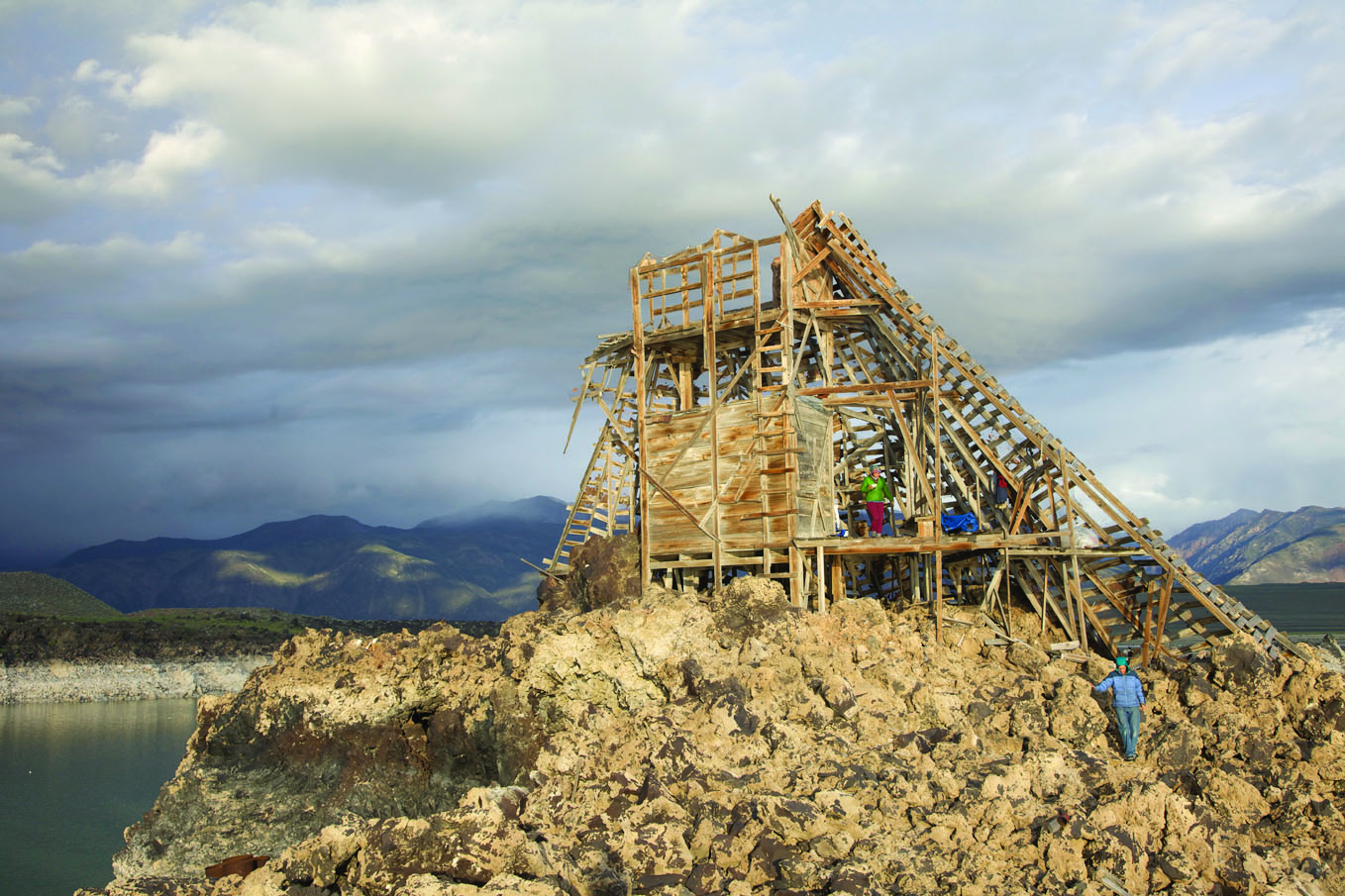
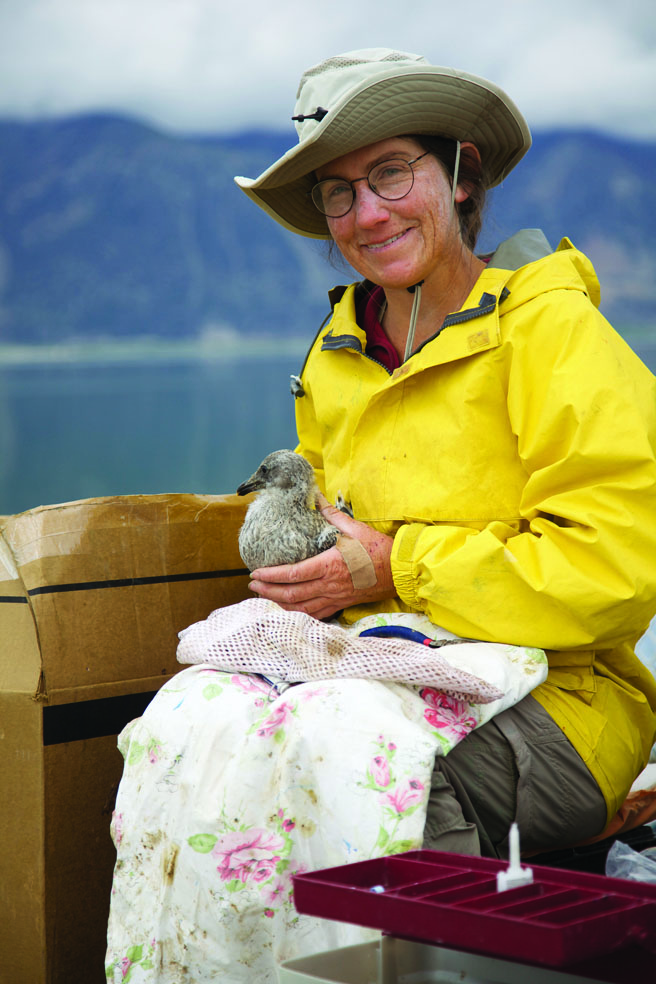
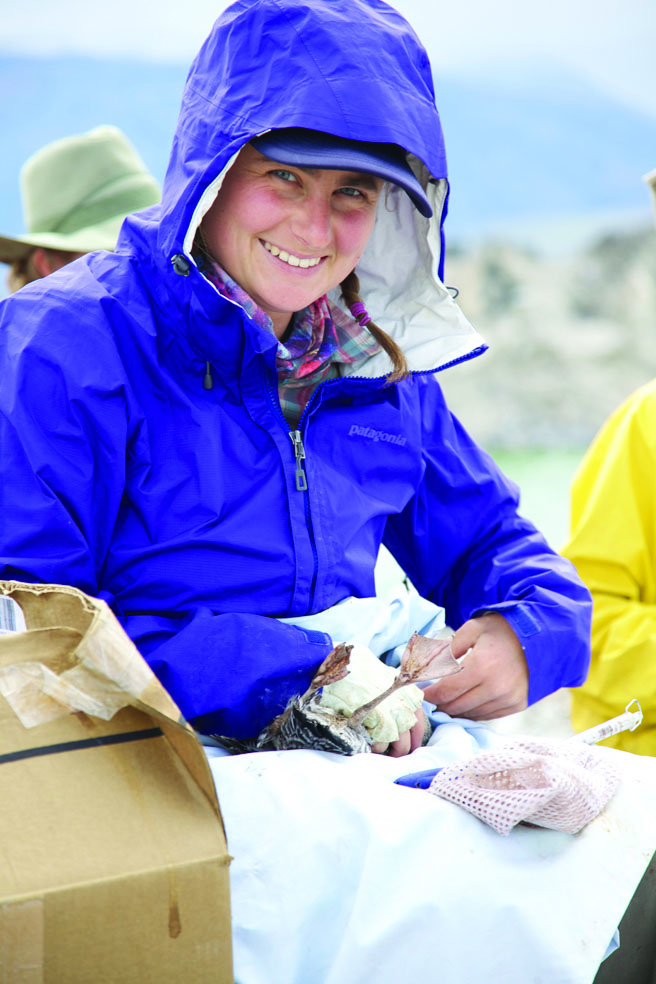
Nelson and her team of six volunteers recently returned from a five day survey and banding of gull chick populations on the lake islands. The team camps on Krakatoa Islet, within the movie set remains of the 1952 film Fair Wind to Java, rising early in the morning to herd chicks into corrals, weigh and band them, and resuming work again in the late afternoon to avoid the heat of the day.
This year Nelson said shade wasn’t an issue; the team was caught in rain and thunderstorms for most of its four nights and five days on Krakatoa.
Team members band the chicks to allow for future identification and survey. Banding allows surveyors to assess the number of chicks per nest, tell a chick’s age, and see whether chicks hatched at Mono Lake return to the lake, or whether they journey to other colonies to breed.
One thing the study has proven is that gulls can live over 20 years. “We’ve had a couple gulls in their upper twenties,” Nelson said. “In 2009, [Project Assistant] Nora Livingston was able to read the band on one gull, and it was from 1983.”
Nelson said she’s also seen banded Mono Lake gulls out at the Farallon National Wildlife Refuge 30 miles off the coast of San Francisco. “I think one day in 2009, I saw something like four or five Mono Lake gulls there,” she said.
Nelson called the annual gull banding “a really neat experience.” She did note that first-time volunteers often comment on the noise of the gulls: “As they’re laying in their sleeping bags they ask, ‘do the they ever stop?’” she said. The answer is no; gulls are noisy day and night.
“I’ve done this long enough that I can listen and generally tell how big the population is, from the noise,” Nelson said. She has managed the project since 2005. Nelson also said she’s gotten used to a more humorous sound; a “unique vocalization that the males make in the spring when they’re copulating. You’ll hear that noise rise up … it’s really hilarious.”
The California Gull Project counts nests in May, prior to the chick banding in July, and returns a third time in the fall after all of the birds have left to count chick mortality, which Nelson said “is usually pretty small.”
The Project has gone on each year since 1983. It now represents one of the longest continually run ornithological studies in the West. “That makes it a very useful tool to look at long term trends, from environmental/climate, to various biological aspects,” Nelson said.
“When the project was initiated in the ‘80s, the future of Mono Lake seemed really grim,” she said. At the time, Mono Lake was home to the largest colony of California gulls, and the second largest in the world after the Great Salt Lake. About 46,000 adult gulls nested at the lake.
“The California gull is a colonial nesting species, meaning large numbers nest in dense, concentrated areas,” Nelson explained. “It’s really important to keep those areas protected, because they represent a large portion of the species.”
But the California gull population at Mono Lake became vulnerable in the 1970’s after stream diversions by the Los Angeles Department of Water and Power (LADWP) lowered the lake level enough to create a land bridge. That land bridge allowed coyotes and other predators to cross from the mainland and gorge upon nesting birds.
By 1994, when the State Water Board mandated the LADWP work toward raising Mono Lake’s level to 6,392 feet, “it seemed like the gull population was saved,” Nelson said. “But with this drought, we’re back to watching that land bridge and wondering if it continues [to form], what preventative measures we could try.”
Due to California’s extended drought, the surface elevation of Mono Lake dropped during 2014 to levels not recorded since 1996. Several islets have already become connected to the mainland, resulting in gulls abandoning those islets once coyotes cross over.
Nelson said one proposed measure to prevent coyotes crossing to major breeding grounds is the erection of an electric fence. She said that only 400 meters of shallow water currently separates the mainland from Twain Islet, which is home to about half the Mono Lake gull population. The distance is even less between the mainland and Pancake Islet, where gulls also nest.
However, she noted that Mono Lake presents challenges to electric fences, such as the lake level rising, mud, or even wind-blown alkali foam shorting the fence.
While researchers and environmental groups keep an eye on the land bridge, Nelson said the California Gull Project continues to provide new insights into how the gull populations respond to different environmental conditions, which can in turn inform management practices.
Nelson said thus far the project has found four variables influencing gull population size: warm temperatures in spring, high concentrations of brine shrimp in spring, reproductive success four years previously (as it takes gulls four years to reach their reproductive age), and the influence of coastal El Niño conditions.
While most Eastern Sierra species could benefit from a wet year after four years of drought, exceptionally large snowmelt runoff years appear to have a detrimental effect on chick production. Nelson explained that fresh water entering saline Mono Lake creates a stratification within the lake. Fresh water doesn’t mix with saline, but rather settles on the top, which “disrupts the nutrient cycling and tends to affect brine shrimp in their size and reproduction.”
So after the “snowpocalypse” runoff year of 2010-2011, Nelson said her team only banded about 178 chicks. That’s opposed to the 896 chicks the team banded this year.
“There’s even years where there have been more chicks than this,” she said.
These dramatic fluctuations in gull chick numbers prove that “even though it’s a very simple ecosystem, we still have an incomplete understanding of the factors that influence chick production,” Nelson said.
She said the study has shown that gulls no longer return to nesting sites disrupted by coyotes in the 1970s. “Gulls used to nest on Negit Island, and then the coyotes got out there,” Nelson said. “Gulls often return to the exact same nest spot each year. But after being hit by coyotes, they tend to just abandon those islands.”
After coyotes reached Negit, gulls chose instead to settle on the surrounding islets.
Like gulls, coyotes also have long memories. “If they learn to wade out to the islands where gulls are nesting now, then if the lake rises, they’ll still have that knowledge and cross more,” she said. “That’s why it is going to be really important to keep the coyotes from learning about this resource.”


