
10 peaks, 10 days, 229 miles, 46,500 feet gain … dayhikes?
“At some point, everybody realizes that they’re here because Bob is working his way down some list,” Bob Burd organizer of the Sierra Peak Challenge of the last 15 years told The Sheet Monday.
A group of long-legged, sun-fried peak baggers have been roaming the area in between hikes, donning the coveted 2015 Sierra Peak Challenge jerseys. These individuals and others are on the Eastside for 10 dayhikes, climbing 10 peaks in 10 days, ascending more than 46,500 feet of gain, and respectively, 46,500 feet of descent and more than 200 miles. This is the 15th year of the unadvertised event that draws 20 to 30 participants but can shrink to less than a dozen by day 10.
The event is part endurance challenge, but as Burd points out, there is sleep involved, “I like to sleep.” It is part fun outing with friends focusing on an objective. And, it’s part sado-masochistic ritual as participants try to survive through the ordeal and all the while, Burd is ticking peaks off his to-do list.
Burd explained the epiphany that led to him taking on the range. He told The Sheet while taking some classes with the Yosemite School of Mountaineering in 1999, Burd wass inspired to ditch the heavy pack, ropes and sleeping bag for super-dayhikes. One of the trips for the course was to the alpine paradise near Big Pine, the Palisades. The Palisades outing was a multi-day expedition, climbers bagging Mounts Sill, North Palisade and Thunderbolt among others. These peaks generally require a rope and harness; couple this and a backpack with a week’s provisions and the adventure became a slog for Burd.
He said he heard about someone doing Mount Ritter as a dayhike and thought he’d give that a try. He then completed the Sierra DS list and wanted to climb more and started on the unnamed peaks. The challenge grew out of an idea of wanting to do these gnarly dayhikes with other people. Burd had gone the Sierra Club route but didn’t go in for its ranking system, allowing people to join on peaks that the club deems within that person’s ability. Burd said people seem to like the organized event and goal but like going at their own pace, going off trail and trying something that might not be on an official roster.
With the challenge, people don’t have to stay in a herd, climb the prescribed peak or another nearby. There are no prizes, except for the jerseys and no fee to pay.
Burd said typically one-third of those who sign up never make it to the trailhead. People sign-up early but never get the time off work, or generally life gets in the way. Sunday’s hike, for example, a fun 24-miler to Johnson Peak, had 20 participants signed up, but only 6 showed at the trailhead with Burd and another 5 started later.
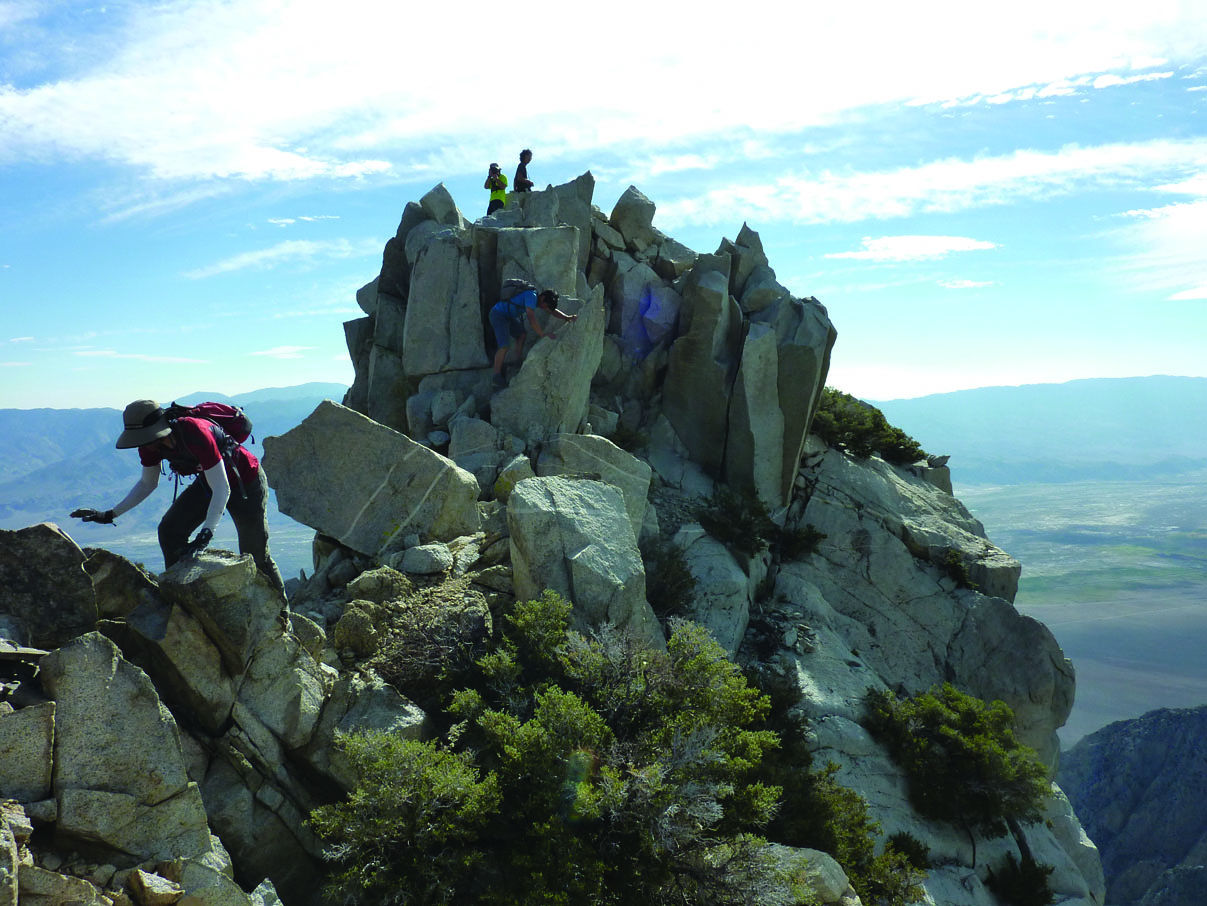
Scrambling along the class 3 summit of Sawmill Point. Photo courtesy: Sheet staff.
Burd retired as an engineer from Silicon Valley seven years ago and so has plenty of time to bag peaks. He said he doesn’t like the idea of endurance races or 24-hour challenges. He said he usually tries to finish a day hike in 12 hours. According to his page at summitpost.org, he climbs hundreds of peaks a year throughout the West. His wife went on a couple backpacking trips while the two were courting but leaves the trails to Burd.
This year, hikers started from the north near Yosemite and lower elevation peaks and worked their way south to Lone Pine, a Burd tradition. The Eastside was chosen for Burd’s adventures because elevation gain is so quick on the lee side of the range, he explained. The Eastside goes straight up, compared to the Westside that requires many miles of slogging to get to high ground. And the Eastside accommodates with easily accessible trailheads, not the miles and winding roads to get to each trailhead on the other side of the mountain.
The fun started Friday, August 7 in Mono Village to tackle Acker Peak, 22 miles, all miles are round-trip estimates, and 5,000 feet of gain then continued on Saturday to ascend the Shepherd Crest near Saddelbag Lake, 14 miles and 6,300 feet of elevation rise. Burd said it rained a little that first day but was pleasant. The hikers traveled to McGee Creek area on Sunday, to steal Robber Baron Peak for another 14 miles and 5,100 feet. That day, one participant tore open the pad of a finger that required six stitches Rock Creek was next on Monday for 15 miles and 4,600 feet to climb for the conquest of Wheeler Crest. Those who have made it this far then drove to North Lake and off to Lamarck Col, visible from the Owens Valley and another 10 miles and 4,400 feet. A big drive and 18 mile hike to the White Mountains and an unnamed peak, 13,615 feet, came on Wednesday. This was the first foray into the range to the east for the Challenge, but was on Burd’s list.
Thursday was no rest day as the hikers embarked on the longest hike of the challenge, Crater Mountain in the Sequoia/Kings Canyon National Park. The hike goes up Taboose Pass, one of the high passes that start at, or near the valley floor between Big Pine and Independence and continues to the crest. The ascent of Crater Mountain is 24 miles round-trip and involves 9,500 feet fn gain. Just down the road near Independence, hikers head up relentless Sawmill Pass to Sawmill/Lookout Points on Friday for another 12 miles and 7,900 feet of gain. Forester Pass and Peak 13,720 came Saturday and another 16 miles and 8,300 feet of gain. The challenge ended Sunday with a light 24 mile hike and nearly 5,000 feet up Johnson Peak (Siberian Outpost) out of Cottonwood Lakes south of Lone Pine.
Burd said with a chuckle, “I think I’ve got my fill of hiking in and am going to rest a while.”
Burd said the views were all beautiful for every hike. The hikers able to avoid the smoke from nearby fires.
The challenge is not a race and no prizes are given, it is also free to participate, stamina required. There are 20 to 35 participants per hike.
There is a scoring system that awards peaks climbed, those on that day’s roster or other nearby peaks. The coveted jerseys are earned through blood and sweat and points.
Like the Tour de France, the yellow Jerseys are worn by the overall leader, the most points and least cumulative time spent on the mountain.
Burd said he loves the bike race and the spectre of getting just a few hours of sleep a night then wrecking one’s body’s on a bike day-after-day.
For the Sierra Peak Challenge, the polka dot jersey, or King of the Mountain jersey, is for those who have climbed bonus peaks, or those in addition to the prescribed peak.
The white jersey is worn by the highest scoring climber under the age of 25; the green jerseys by the over 50 crowd.
There was a fatality in the 2013 Challenge. Pat Hadley, a 54-year old high school teacher from Placentia was attempting North Diamond Peak near Independence. According to a trip report from Burd, Hadley was descending the southeast slopes of the peak when a rock slide took her with it. Burd recalls reaching the summit of Diamond North himself, but didn’t recognize that Hadley’s name was not in the summit register.
Hadley’s body was later discovered by other climbers reaching the summit. The rest of the challenge was canceled that year.
Since then the peaks chosen for the challenge no longer require technical rock climbing skills, but Burd explained it’s not because of the accident. He said his list of peaks to climb is dwindling and the peaks are becoming less technical. The use of crampons and ice axes to cross or climb glaciers has been set aside. This is due to the drought.
As it turns out a list is never completed and Burd is always adding new peaks. He said he will keep doing the challenge until it’s not fun anymore or the knees give out.
For more on the challenge and detailed descriptions of the climbs go to summitpost.org.


