
Verizon pleads poverty
Oh, so that’s why they can’t hook up Digital 395.
One of the nation’s leading telecommunications companies, Verizon told a judge on Aug. 21 in Mammoth that it did not hook up to the area’s broadband service network, Digital 395 (D395), because it was too expensive.
The testimony came at a public hearing and workshop held by the California Public Utilities Commission (CPUC) to inform/hear from the public about the transfer of Verizon California land line, internet and video services to Frontier Communications for $10.6 billion.
The main issue folks had about Verizon concerned its lack of leveraging D395.
“I’m pissed,” Rudy Archuleta said of Hammill Valley, an area notorious for having bad communication systems. He said he gets no cell service at his home, the landlines barely work and he’s afraid if he or a neighbor has a heart attack and tries to call 911, the call won’t go through.
“Digital 395 is eight feet from my house,” said Archuleta, “nobody gives a shit about us.”
When Verizon’s lines went down during the Round Fire in February, it took with it 911 emergency and dispatch services for Inyo and Mono counties. Verizon has no redundancy in its local system; it is a closed loop stopping in Bridgeport, so when the lines went down, so did all service. Verizon spliced into Digital 395 and restored service shortly after the fire but unplugged from D395 once it fixed it’s own antiquated copper lines. Had Verizon been connected to D395, one of the fastest highest-capacity fiber optic networks in the nation prior to the fire, there would not have been a disruption in service. The CPUC brought its own judge and court reporter to ask Verizon why it had not hooked up to D395 or done anything to maintain, much less upgrade its infrastructure.
Administrative Law Judge Anthony Colbert asked Alan Reilly, Engineering Director for Verizon California if Verizon ever intended to hook up to D395, before or after the Round Fire.
Reilly said Verizon was approached by D395 in 2012 but an acceptable price could not be negotiated.
Colbert interjected quickly that one of the biggest issues brought up at the 10 previous public hearings and now at the Mammoth meeting was Verizon’s “unwillingness to invest” in its infrastructure. Colbert said it appears that Verizon has done as little as possible to keep up its current infrastructure much less keep up with the times and Gigabit service demand.
Reilly claimed Verizon is aggressively investing in upgrades.
Colbert jumped in again, “Digital 395 must have had some benefits because you hooked up to it?” He added that Verizon’s resistance to D395 because of price was unacceptable to him.
In Verizon’s 2014 Annual Report, it reported $13.8 billion in free flow cash and total operating revenue of $127.1 billion, $38.4 billion of that coming from landlines. All the figures were up five percent from 2013.
Verizon’s focus on the bottom line is a public safety hazard.
Mono County Undersheriff Michael Moriarty gave his impression of the condition of Verizon’s network, “It’s a disaster waiting to happen.”
The lines have been “fixed” since the Round Fire, but the lines are still on poles, Moriarty testified. Another fire, flood, or vehicle versus pole accident could take down the lines, and, again, the 911 system with it. This includes the reverse 911-system used to notify the public in case of an emergency, like an approaching fire or evacuation orders. “We’re as vulnerable today as we were the day before the fire,” he told the judge and CPUC Commissioner Catherine Sandoval.
“If it goes down again, we’re back to having deputies driving the streets with blow horns,” Moriarty said.
Mammoth Lakes Police Chief Al Davis, Mammoth Lakes Fire Chief Frank Frievalt and Moriarty all testified that a lack of redundancy in the system was crucial in this remote, isolated area.
Coincidently, the town was choked with smoke from wildfires the evening of the meeting.
Fires and floods are not new, Colbert said to Reilly, yet Verizon has not made efforts to build redundancy into its system.
Reilly went on to explain the dramatic events of the Round Fire and the cooperation that went into getting services restored. The story was complete with congratulatory remarks
toward local workers and agencies but ended with no information about Verizon hooking up to D395 because, Reilly explained, the negotiations between the two are still ongoing.
In its annual report, Verizon says, “We also continue to move customers off legacy copper networks onto the more powerful and efficient fiber platform, which not only delivers more value to customers but also improves the network’s reliability. Not many companies have both the commitment and the financial capacity to invest $16 billion to $17 billion in infrastructure, year after year, but we know that’s what it takes to deliver the kind of reliability, speed and ubiquity our customers demand.”
Frontier has already acquired lines north of Bridgeport (from Verizon) and would have redundancy in the lines should the deal go through. Frontier is not an internationally recognized telecommunications giant like Verizon, but Frontier handles rural land lines in 23 states. Frontier does not have a wireless service subsidiary, but it does have a “100 percent US based work force” of 17,000 meaning service calls will be handled in the states not overseas. The nearly 4,000 Verizon workers affected will move to Frontier. Frontier also hopes to leverage money available through the federal Connect America Fund to bring $3.8 million for broadband service to the Mammoth area. Frontier would receive the funds via Verizon should the deal go through and pending approval by the Federal Communications Commission, Steve Crosby, Public Affairs Officer for Frontier told The Sheet. He added that Frontier will also be investing in in the network and not relying solely on grant money.
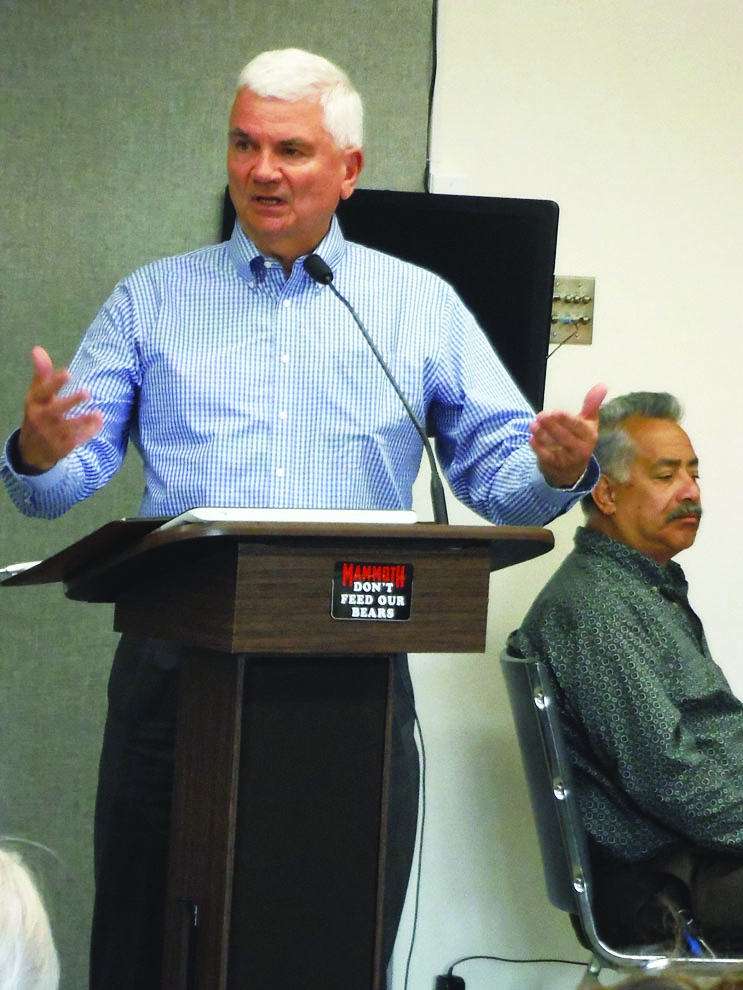
Tim McCallion, Regional President for Verizon California, doesn’t feed bears, only dissatisfaction. Photo courtesy: Sheet staff.
Mono County has filed a complaint against Verizon for failing to provide adequate service in Hammill Valley, according to District 2 Supervisor Fred Stump. Stump’s complaints echo those before him; lack of redundancy, failure to leverage D395 and putting the copper wires back up on poles after the Round Fire.
A handful of public citizens at the meeting expressd their attitudes toward Verizon.
Catherine Canon of Hammill Valley talked about Verizon’s lack of sensitivity to the plight of people who live in rural areas. She said she can’t get a response for a service call from Verizon, but the company will respond to Benton or Chalfant Valley. While she was giving a fairly impassioned speech, one representative from Verizon was busy checking a social media page on his smart phone.
The social networking continued while Greg Newbry told his story of not knowing the Round Fire was approaching his home until deputies arrived, physically, to warn him. Newbry said that even though the CPUC has told Verizon to hook up to D395, Verizon refuses. He said Verizon should have a responsibility to serve its customers and asked the CPUC to look into Verizon’s “profound lack of sensitivity” when serving rural area clients.
Representing the county and town’s technology departments was Kirk Hartstrom, He testified that the government’s biggest concern with the network was its reliability. He described landlines going down, T1 lines needing constant repair and Verizon’s failing infrastructure.
Crappy service isn’t good for business either. Town Manager Don Holler said tourists are “under-whelmed” by local internet service and lack of WiFi. He explained the service, “Speaks poorly for the town and for the companies providing service (AT&T, Verizon, Suddenlink).”
Tourism puts a strain on Verizon’s infrastructure when Mammoth’s population jumps from 8,000 to 30,000 in one day. Davis and Frievalt both explained the need for a network that can handle the surge and future data growth. The Incident Management Team at the Walker Fire, for example, has put a strain on the network with needed communications.
Mono County Supervisor Stacy Corless requested the CPUC make Frontier commit to hooking up to D395. Frontier is currently spliced with the fibers in the Gardnerville area. Inyo County Supervisor Jeff Griffiths said he believes that on a broader level there should not be a divide for access between rural and urban communities.
The 11 meetings must have been taking a toll on the Verizon Public Relations folks. They were a well dressed group seated in a row with sullen faces.
Verizon reps were quick to respond to the handful of customer complaints after the meeting, getting names and addresses.
A ruling is expected on the transfer by December.


