
More ebb than flow
Mammoth Creek appears to be running on empty.
There is barely a trickle of water flowing in Mammoth Creek. The Los Angeles Department of Water and Power’s survey water gauge located on the creek near the intersection of highways 395 and 203 measures 0, zero, water flow.
The section of Mammoth Creek in Long Valley between the gauge and Hot Creek Fish Hatchery flows intermittently between dry channels and shallow pools. The small springs along the channel are keeping the creek flowing. The creek runs through Chance Ranch where fishing is prohibited. It is rumored the fish there are huge and some of the last wild fish left in the region. California Department of Fish and Wildlife said some fish may die, but this is because of the drought.
Spring flow is down at the hatchery that gets its water through the many springs that surround the facility. The hatchery has cut its production in half.
Jim King, Mono Fisheries Commission vice chair told The Sheet there could very well be some very large and semi-native trout in the water that flows through Chance Ranch, but it is nearly impossible to confirm rumors because access to the property is difficult. The property was bought by the Los Angeles Department of Water in 1967.
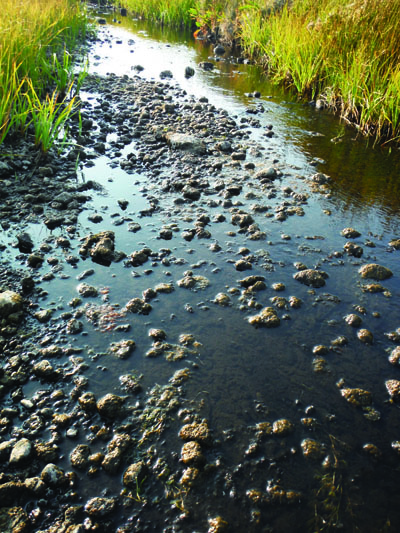
Islands in the Stream. Not exactly what Dolly and Kenny had in mind. Photo courtesy: Sheet staff.
The California Department of Fish and Wildlife is watching the development, or lack thereof, closely and managing Hot Creek Hatchery accordingly. Andrew Hughan, public affairs officer for DFW said from Sacramento that the hatchery is cutting back on production, from four raceways to two. If the water gets even lower the hatchery will go down to one raceway. A complete lack of water would mean the ultimate management practice, evacuating the hatchery as DFW has already had to do to three state hatcheries, the San Joaquin, American River and Kern River.
Hughan explained evacuated fish, the little guys would be taken to other hatcheries, such as the Hetch Hetchy facility with a reliable supply of cold water. The big boys, the brood stock would be given their freedom in local waters. Hughan said this could be an anglers dream with dozens of trophy fish set loose in shallow waters, but not such good news for the hatchery.
He added that the DFW has no plans to restrict fishing in local waters. At the beginning of the summer, the DFW proposed banning fishing and reduce or stop stocking in waters that were too shallow or too warm to sustain fish. Hughan said he encourages people to get out and fish. He explained there’s only 40 percent of the water but 100 percent of the fish.
Hughan added that while it is unfortunate that some fish may die, such is the reality of a drought.
The Mammoth Community Water District (MCWD) has not diverted nor is using any surface water this year, according to Operations Superintendent Karl Schnadt. He said MCWD has already implemented Level 3 water restrictions and looks everyday to see if it’s time to rise to level 4.
Hughan said he’d never seen the creek so low, but he also recounted that 2014-15 has been the driest year on record.
Many people may not realize the natural disaster that is slowly happening before their eyes, Hughan said. Unlike a flood or fire that can sweep through a community with little warning or time to defend against it, the drought is a cumulative process, with each dry year lowering the groundwater level, drying or killing flora, disrupting or even decimating ecosystems and dry brush becomes fuel for a wildfire. He said the drought situation is serious and there’s no way of knowing how long it will persist.
Hopefully, the end is near. Hughan said the latest El Nino forecasts for a wet winter look promising.
Schnadt said he has observed small springs popping up along Mammoth Creek.
Hydrologist Sue Burak explained that springs and stream flows will increase slightly this time of year because plants are not using the same amount of water as they do in the growing season. “People don’t realize how much water plants use,” she said.
What the area needs to replenish groundwater is a good snow year. Burak explained that rains don’t do the same job as snowpack, all water is not created equal. Snow melts slowly and fills creeks and lakes on the surface, like Mammoth Creek but also trickles down to the groundwater.
Trout are hardy specimens and adapt to drought by searching out pools to survive in, King added. But, if the water is too shallow the fish may not be able to survive the winter.


