
Hospice shortage
End-of-life care hard to come by in rural areas.
Bill Sauser sits outside his Manzanita Street home on a warm fall morning, waving a hand at the rabbits running in his yard and speculating on the decreased coyote population, which has allowed the Belding’s ground squirrels and cottontails to overrun his hard-won garden.
This is the house in which his mother, June Sauser, died last summer. During her last weeks the family dispensed with their dining room table and rented a hospital bed “so that she could look out her dining room windows, which is what she loved to do most, and see her chipmunks and rabbits and birds,” said Sauser.
The Sausers say that June’s passing was eased by the help of Pioneer Home Health in Bishop, which sent staff members to Mammoth to counsel the family on what June needed in her final days. “The value of that care is incalculable. No matter how strong you feel you are and how much you’re sure you’ve done all the planning to get through this as a family and on your own, you’re not gonna make it without their support” he said.
However, had June Sauser lived in Walker, Bridgeport or anywhere in Mono County north of June Lake, her family would not have had those visits from the area’s only licensed in-home end-of-life care provider. Due to budget restrictions and the vast size of Mono and Inyo counties, Pioneer has been forced draw a line in the sand about where they are able to provide services for people needing care.
“We don’t have a lot of people and they’re in such small pockets spread out across this huge area… [the two counties combined are] the size of the state of Maryland. So we are bigger than a state, and that state of Maryland has 80 home health agencies…and we have one. One that’s very stretched,” said Pat West, director of Pioneer Home Health.
“But it’s not feasibly possible to have more than one [agency] because there aren’t enough nurses and therapists here to support it,” West exaplined. “It’s very difficult and it’s very costly to go a long distance to see a patient.”
Pioneer, which has been operating in Bishop since 1990, is not yet an accredited “hospice.” More than a physical location such as a nursing home, hospice “is a philosophy of care for people who have a life-limiting or terminal illness,” said Spencer Levine, Vice President of Programs for the Hospice Foundation of America. “The overwhelming majority of people who receive hospice services receive those services wherever it is they call home.”
“The hospice care is delivered by an interdisciplinary team of clinical professionals,” said Levine. “There’s a physician, there’s also a nurse, there’s also a medical social worker. Often when a person is that ill, the family dynamics change, and that happens often, so a medical social worker can be helpful in addressing issues like that, identifying community recourses to meet needs that the family may have. There’s also a spiritual component…hospice [sends] somebody who is a non-denominational chaplain to discuss the spiritual part of the whole journey.”
Pioneer Home Health is currently awaiting a state survey, after a two-year application process, that will finally allow it to be certified as a hospice provider and send the group of professionals to serve the two counties. This certification will also make them eligible to receive Medicare funding for end-of-life services. About 85 to 90 percent of people who receive hospice are on Medicare, said Levine. These funds help pay the specialized staff that hospice requires.
“These people all have their professional training and proper licensure and many have additional credentials that represent training for hospice and palliative care,” said Levine. “One cannot just ‘decide’ to give this kind of care.”
This makes Pioneer’s role crucial to those needing end-of-life support. It is the only facility in the area that is currently taking on in-home visits in Mono County. Other agencies, such as Bishop Care Center and Southern Inyo Hospital’s Skilled Nursing Facility, do provide end-of-life services on a live-in basis but only in Inyo County.
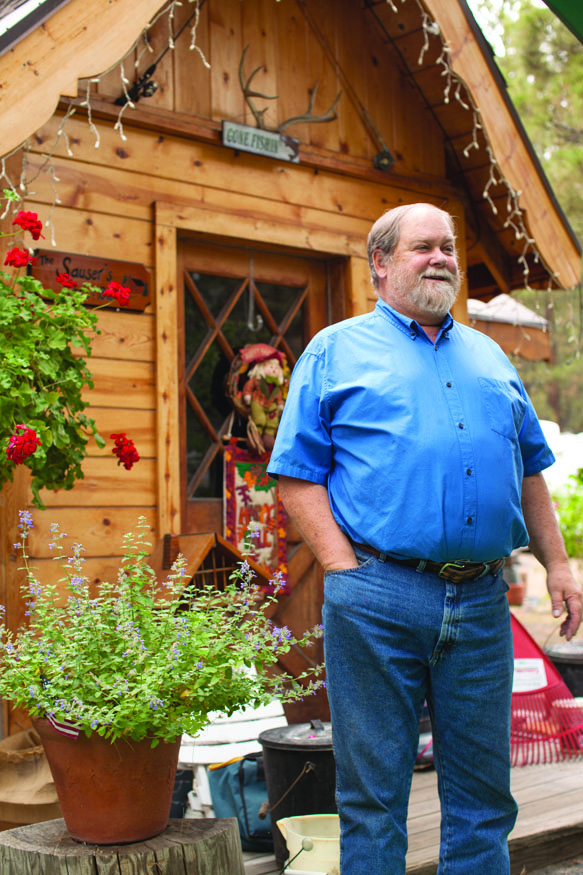
Bill Sauser. Photo courtesy: Sheet staff.
“Once upon a time there was a volunteer group that put together a [care] program, they were…affiliated with Northern Inyo [Hospital]” said West. “They were all volunteers. They were not licensed but they did have a building on the hospital campus. They had two challenges: one, they only covered a very small area, Big Pine and Bishop, and two, they didn’t have enough human resources, i.e. nurses, or funding to really sustain themselves. They didn’t want to go through the process of licensing so we took the challenge and it’s been a very lengthy process … it was very challenging at the state level to start a small hospice program. It took us all last summer to agree upon working with the state, legislators, working with licensing to really come to an understanding of what would be expected of a small agency. We sent our application in last February and we’ve been waiting for this survey that will take place [in October]…so finally it’s going to happen.”
For some, like Bill Sauser, letting June pass peacefully at home was the only option they wanted to entertain. The family was together, the walls were familiar, the smells comforting, “We had been her caretakers here for [years] so that she could die at home,” said her son.
“If you stop and think about the population base…the average number of people that die [per year in Inyo and Mono Counties] is about 175…so our hospice program will never be a big program,” said West. Furthermore, she said, only about 40 percent of those eligible in the US actually choose to take advantage of hospice care. “If you do the math, what’s 40 percent of 180? That’s maybe 70 people. So even if we captured everyone we could, we’d help out about 70 people in a given year, and that’s our long-term goal. And it’ll take a while to educate the community about what hospice is and what we can do.
“We’ve kept track of…how many people we’ve taken care of in home health that could have been in hospice and that’s about 58 or 60 [last year], so that’s pretty good!”
However, there are currently several patients in north Mono County in need of end-of-life care who are unable to receive in-home visits due to their location. “We’ve certainly given it consideration how far can we stretch our resources. If your human and financial resources are limited then you’re forced to draw a line somewhere. Whether it can at some point expand? I…think we really have to give an opportunity to see how we grow and see how much our resources can cover,” said West.
“It’s very difficult and it’s very costly to go a long distance to see a patient. A nurse goes in a high-rise apartment building and she sees five different people without ever getting in her car. Out here our nurses, our social workers spend hours in the car…we’ve done enough mileage in the last 25 years to get to the moon and back.”
However, “when somebody’s ill, they don’t want to hear excuses,” said Mono County Supervisor Tim Fesko, who brought the issue to the attention of The Sheet. “Right or wrong…people don’t want to leave home [when] they’re terminal…if you’re on your death bed, and I can’t even imagine what that feels like, you don’t want to leave home, that’s the only thing you know.”
The options are admittedly limited. When Mona Logan, RN Case Manager at Mammoth Hospital, was asked about end-of-life care in Mono County she began to look up her “list of resources,” paused and said, “so by list, I mean one other” option. This is a live-in Skilled Nursing Facility in Gardnerville known as Gardnerville Health and Rehabilitation Center, and the facility does accept patients from California.
However, “if they come across this imaginary [state] line, guess what?” said Fesko, “they have to meet a whole other set of criteria.” For a patient who is dying in Coleville, for example, crossing the state line to die becomes an endeavor fraught with bureaucratic hoops and frustrating to a family that is dealing with the impending death of a loved one. “When you’re basically told, ‘well, just drive ten miles over the border to Topaz…then you’ll get hospice,’” the lack of resources in rural North Mono County becomes woefully apparent, Fesko added.
“Unfortunately it does come down to money. They have to put tires on their cars, they have to pay for gas,” said Fesko, speaking of Pioneer’s staff. “Even though I understand, I’m trying not to really accept that.”
Like so many issuses in rural America, care for the dying in Mono County comes down to resources. “We need more financial resources but we also need more human resources. We need more nurses, therapists, social workers, chaplains, volunteers,” said West. “Its an entire program that needs all of those members on the team …
Once upon a time we actually did home health all the way up to the Nevada border but we were only able to do nursing that far, and of course when the nurse went up there she spent all day just seeing one patient… so it becomes very costly. Now, our [anticipated hospice] licensing says you can’t go up there and just do nursing, you have to have the whole home health team…so we had to draw back our boundaries where we were able to provide our whole team.
If I had the capacity to provide this care to everybody in our two counties, we’d be doing it. But the ability to do it and do it correctly, there are not the resources to make it happen.”


I am in the north county and willing to volunteer. I know a pastor that would, more than likely, volunteer his services.