
June Mountain turns a page
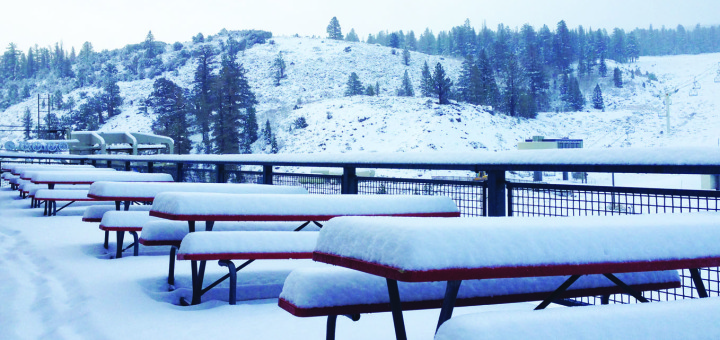
Community hears plans for Resort’s future and prepares for December 13 opening.
Recently branded as ‘California’s Family Resort,’ June Mountain Ski Area (JMSA) is set to open Saturday, December 13, operating four lifts with another two expected to open on Sunday.
“The forecast is promising. I will open the entire mountain as quickly as possible, ” said JMSA General Manager Carl Williams at the Citizen’s Advisory Committee (CAC) at the June Lake Community Center on Tuesday, December 9.
Greg Dallas, COO of Mammoth Mountain Ski Area (MMSA), parent company to JMSA, was also at the meeting. He was adamant about the resources and attention being poured into June just two years after closing the resort due to financial loss. MMSA reopened the mountain last winter.
“I run about $70 million dollars between Mammoth and June for mountain operations,” Dallas said. “Everyone competes for resources in the company and I want to make sure you understand that June Mountain, like never before, is getting the same attention as every one of the other business segments. It started last year and it’s only ramping up.”
Recapping operations from last season, JMSA saw a net loss of $1.23 million with only 23,000 total skier visits as opposed to a budgeted 70,000. Williams showed pictures of June employees pruning trees on Mambo, shoveling snow to put on the ramps for access to the lifts, and blowing snow out of the trees and onto the runs. “To us it was worth it,” he said. “But we’d like to put last year behind us.”
In an effort to mow the ski runs, allowing the resort to operate on only a few inches of snow, MMSA sent a large piece of equipment over to June during the summer. “I think you all know the results of that machine showing up at June that day. All our worst nightmares really came true,” Williams said.
Sparks from the machine started a wildfire that burned 65 acres in September, closing Highway 158 and forcing residents to evacuate. Fire crews from a variety of agencies were able to contain the fire before it damaged any property.
“The fire was really hard on us as a company. We made a mistake,” Dallas said. “I want to thank you all because that could have been a very difficult, adversarial dialogue with the community. That could have been very different a few years ago.”
Moving forward, “We’re trying things we’ve never done before with June,” Dallas said. Such efforts include free skiing for kids 12 and under, lift and lodging packages with non-MMSA lodging partners, and a reciprocal pass program with Diamond Peak and Homewood resorts in Lake Tahoe, and Red Lodge Mountain in Montana.
The new June Mountain website offers lodging reservations with The Villager Motel, Boulder Creek Lodge, Whispering Pines, Double Eagle Resort and the Yosemite Gateway Chalets.
“We aren’t doing this in Mammoth and yet we’re going to allow the ability to put in-town lodging partners up on the website,” Dallas said. “This is a real significant effort from marketing and Mammoth to put focus on June.”
Although June Mountain specific season pass sales were down 50 percent this year, Abigail Ross, Sales and Marketing Manager, emphasized the Cal4nia pass, which includes June, Mammoth, Big Bear and Snow Summit. “48,000 people have purchased that pass,” she said. “That blows our pass sales out of the water for the last 50 years.”
Future operations are focused around U.S. Forest Service applications to expand snowmaking efforts and rebuild June’s Chair 1. June Mountain received approval to drill test wells for snowmaking on October 1 of this year. Dallas was adamant that MMSA believes there is water up on June sufficient for snowmaking, as he fielded several questions about a fallback plan if it’s not.
“If we don’t have water, we don’t have snowmaking, and it’s going to be a bigger discussion,” he said. “But I think it would be very premature for us to figure that out now.”
Another question: Does the current Chair 1 provide the service capacity needed for the ski area?
“No. But at what service level do we think Chair 1 is not good enough? President’s weekend it isn’t good enough. But we have the same situation over at Mammoth,” Dallas said. “We don’t build ski resorts for Sundays, so to speak.”
Dallas affirmed several times throughout the meeting that Chair 1 needs to be a gondola, although he admitted there is still internal debate on the issue.
Williams also chimed in. “We know there are some people who just won’t ride Chair 1. But I don’t think the lift alone is going to solve the issue,” he said. “At the end of the day, it’s about the snow.”
“Snowmaking is absolutely essential if June is going to be viable,” Dallas corroborated. “We can’t build a lift to nowhere.”
Currently, June’s snowmaking efforts cover less than 5 percent of the mountain. The snowmaking plan submitted to the USFS “is about 250 acre feet, which gives you about 450 acres of snowmaking,” Williams said. “Based on historic temperatures and weather, we could open 80 percent of the mountain 8 out of 10 years.”
After the company demonstrates there is enough water for snowmaking operations they will have to gain approval from the Forest Service to actually extract it, which will include a full environmental analysis in accordance with the National Environmental Policy Act (NEPA). Williams said this process could take up to three years, if not more, “depending upon public involvement or opposition,” he said.
Ross also announced June will be open for summer operations in 2015, with chair one running Friday through Monday and lunch served at the chalet. And Ross is already taking reservations for weddings and other events.
When asked about expanding Summer Operations to include other activities, such as mountain biking, Dallas said, “If you look at the master plan, there are all sorts of ideas. But again, it’s tough to talk about it after the last four years.”
At the end of the meeting, Jane Johnson, June Lake resident for 35 years, commended Dallas for his honesty. “The good thing that comes out of this open dialogue is that it gives people hope that June isn’t just something of the past and that transformation is underway,” she said. “It’s nice to know that June can turn a page and keep the story going.”


“Snowmaking”? Talk about wrecking the environment…. Mountain biking also doesn’t belong.
Bicycles should not be allowed in any natural area. They are inanimate objects and have no rights. There is also no right to mountain bike. That was settled in federal court in 1996: http://mjvande.nfshost.com/mtb10.htm . It’s dishonest of mountain bikers to say that they don’t have access to trails closed to bikes. They have EXACTLY the same access as everyone else — ON FOOT! Why isn’t that good enough for mountain bikers? They are all capable of walking….
A favorite myth of mountain bikers is that mountain biking is no more harmful to wildlife, people, and the environment than hiking, and that science supports that view. Of course, it’s not true. To settle the matter once and for all, I read all of the research they cited, and wrote a review of the research on mountain biking impacts (see http://mjvande.nfshost.com/scb7.htm ). I found that of the seven studies they cited, (1) all were written by mountain bikers, and (2) in every case, the authors misinterpreted their own data, in order to come to the conclusion that they favored. They also studiously avoided mentioning another scientific study (Wisdom et al) which did not favor mountain biking, and came to the opposite conclusions.
Those were all experimental studies. Two other studies (by White et al and by Jeff Marion) used a survey design, which is inherently incapable of answering that question (comparing hiking with mountain biking). I only mention them because mountain bikers often cite them, but scientifically, they are worthless.
Mountain biking accelerates erosion, creates V-shaped ruts, kills small animals and plants on and next to the trail, drives wildlife and other trail users out of the area, and, worst of all, teaches kids that the rough treatment of nature is okay (it’s NOT!). What’s good about THAT?
To see exactly what harm mountain biking does to the land, watch this 5-minute video: http://vimeo.com/48784297.
In addition to all of this, it is extremely dangerous: http://mjvande.nfshost.com/mtb_dangerous.htm .
For more information: http://mjvande.nfshost.com/mtbfaq.htm .
The common thread among those who want more recreation in our parks is total ignorance about and disinterest in the wildlife whose homes these parks are. Yes, if humans are the only beings that matter, it is simply a conflict among humans (but even then, allowing bikes on trails harms the MAJORITY of park users — hikers and equestrians — who can no longer safely and peacefully enjoy their parks).
The parks aren’t gymnasiums or racetracks or even human playgrounds. They are WILDLIFE HABITAT, which is precisely why they are attractive to humans. Activities such as mountain biking, that destroy habitat, violate the charter of the parks.
Even kayaking and rafting, which give humans access to the entirety of a water body, prevent the wildlife that live there from making full use of their habitat, and should not be allowed. Of course those who think that only humans matter won’t understand what I am talking about — an indication of the sad state of our culture and educational system.
It is ignorant, misinformed people like yourself that spread total lies to further your radical, unrealistic agenda.
Our Public Lands were not designated as such exclusively for conservation and protection of the environment, the land, and inhabitants of the land. When designated they were intended for many purposes, including recreational activities like skiing and mountain biking.
The FACT is ski areas occupy less than a half of one percent of all national forest service land. The impact from snowmaking and mountain biking on the surrounding environment and wildlife is almost undetectable and of little concern. Even if all of the ski areas in the United States were to double it would still only account for 1% of US Forest Service land. That leaves 99% of the land for other purposes including wilderness protection and conservation. We also know that the economics behind such an expansion, much less no need for such massive growth in ski terrain, will prevent that from ever happening.
Another FACT is that the majority of our public land is undeveloped wilderness. Take a flight across California, Colorado, Utah and numerous other states and you’ll see millions of acres of undisturbed wilderness. This fact disputes any claims that an increase in recreation within current ski area boundaries will have any serious impact on anything.
Most ski areas would be considered developed acreage and reside near areas that are developed as well. Few occupy lands that would be considered pristine, untouched wilderness.
However, I find it oddly amazing how despite claims from people like yourself wildlife can easily co-exist with humans and their activities on the lands where they live.
Finally, June Mountain is a business that affords the public the opportunity to enjoy recreation on our public lands. Furthermore, it is important contributor to the economy of June Lake, California and provides important jobs for those who desire to live there.
The fact is your agenda is really anti-business, not one of protecting the environment and critters. You just hide this fact behind your bogus claims.
“spread total lies”? It’s revealing that you couldn’t manage to quote a single lie. That’s because there aren’t any! You also claim that I’m “ignorant”, when I’m fully aware of everything you say. What you left out is that (1) if we had enough wildlife habitat left, there wouldn’t be such a thing as endangered species, nor a need for the Endangered Species Act. (2) Actually, something like 99% of wildlife habitat has been destroyed or made ineffective by too much human presence. We can’t afford to lose any more, ESPECIALLY for frivolous activities such as mountain biking. Wildlife habitat doesn’t exist to be racetracks for adrenaline junkies who speed through it without so much as a glance at the wildlife – just because they are too lazy to walk!
No one wants to live in a society where government regulations control our every move. But that requires that people use common sense, so we don’t need a policeman or ranger on every corner. I know that you can figure out how to make a living without wrecking the environment. Others have done so. You can, too. A word to the wise….
Common sense tells us the following:
– Ski areas utilize so little public land that their impact on wildlife and habitat is largely insignificant.
– Ski areas are developed acreage, not wildlife habitat, thus they are not the place to protect endangered species or wildlife.
– Since a ski area is already developed wouldn’t this be a great place to offer mountain biking versus on trails that lead into the wildnerness? That’s common sense.
Your problem is that you want to ignore the FACT that public land was meant for a variety of purposes, not exclusively conservation.
Finally, 2% of all land within the United States of America is developed. That fact comes from a study commissioned by Bill Clinton’s administration and that fact tells me that there has been very little loss of habitat for wildlife. So therefore, possibly the extinction of animals and critters has more to do with the evolution of the earth and less to do with human involvement. In some cases humans have hunted animals to extinction, but as we’ve grown more aware we’ve changed our ways.
However, ski areas and mountain biking within a developed ski area’s boundaries pose little threat to the environment. Anyone with common sense can draw that conclusion.